About Meganephria bimaculosa Linnaeus, 1767
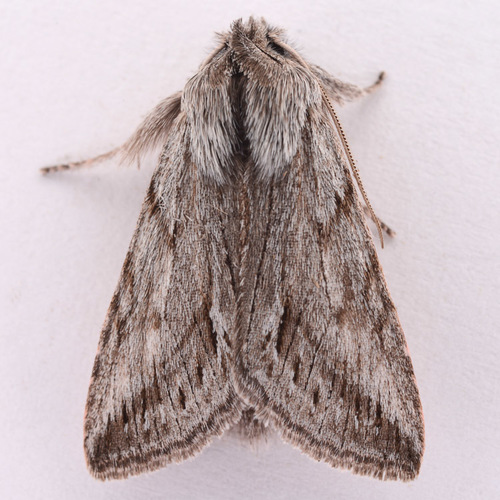
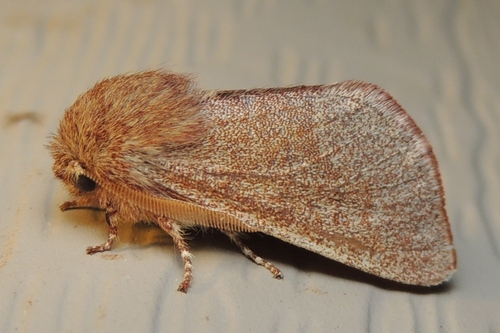
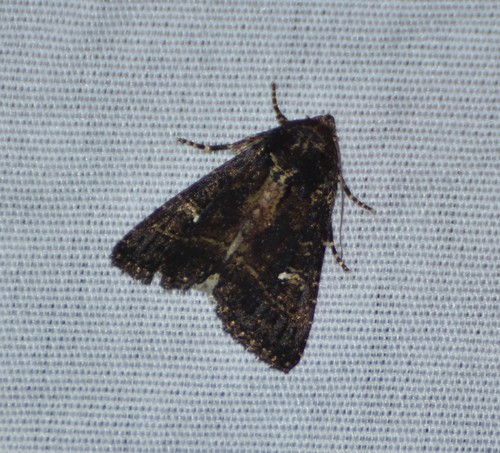
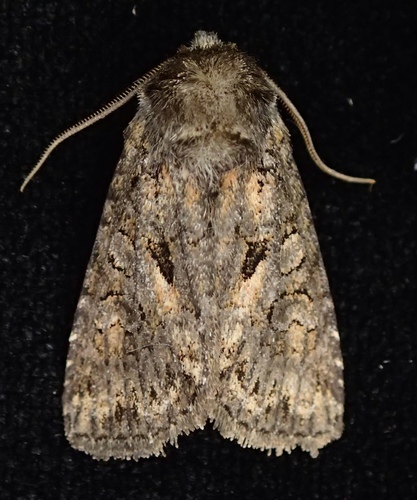
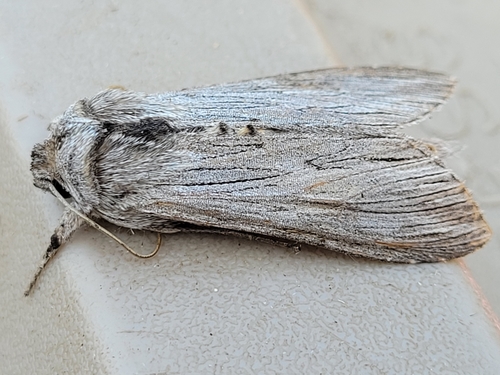
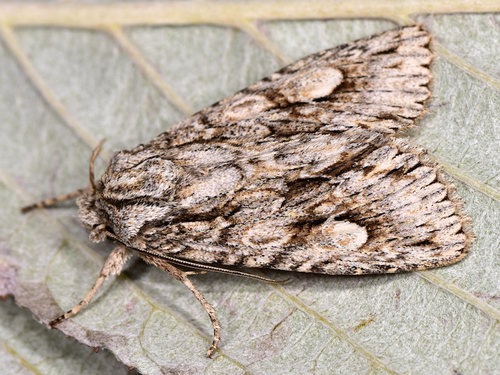
Forewings are whitish grey, speckled with darker scales, with olive brownish shading that fills the outer half of the median area between the subcostal vein and submedian fold. A thick dark streak runs from below the cell base. The inner double line is oblique and angulated, darker on the outer side. The outer line is lunulate-dentate and double. All stigmata are large, rounded, pale grey dusted with darker pigment; the reniform stigma is white externally, with a black line along its base above the median vein. Veins toward the termen are dotted with black; margin intervals bear redbrown dentate markings. The submarginal line has a rufous dentate shade before it, and is crossed by a diffuse dark shade on the submedian fold. Hindwings are pale and darker grey; a large cell blotch and a marginal blotch on the submedian fold are blackish, with an obscure darker outer line and a pale grey marginal area. Larvae are brown, darker toward the front; the dorsal line is narrow and pale, with 4 white tubercles on each side. The lateral lines are waved, dark-edged above and paler below; the 11th segment has a two-pointed hump. The wingspan ranges from 50 to 58 mm. This description follows that published in Seitz.