About Megaloprepus caerulatus (Drury, 1782)
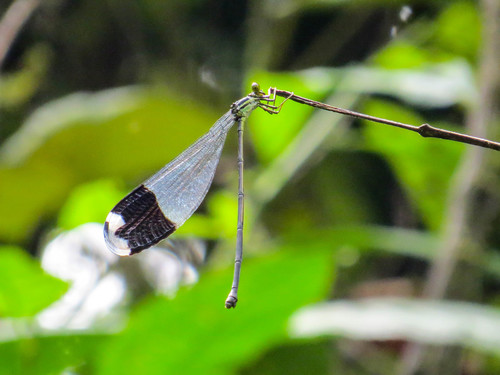
Megaloprepus caerulatus, also commonly called the blue-winged helicopter, is a giant forest damselfly belonging to the family Coenagrionidae. In the past, forest giant damselflies were classified as their own separate family, Pseudostigmatidae. This species occurs in wet and moist forests across Central and South America. It has the largest wingspan of any living damselfly or dragonfly; the largest males can reach a wingspan of up to 19 centimetres (7.5 inches). Its large body size and distinct wing markings make this species easy to spot; a hovering individual of Megaloprepus has been described as a "pulsating blue-and-white beacon".
Adult M. caerulatus feed on orb-weaver spiders in the forest understory, plucking the spiders directly from their webs. Females lay their eggs in water-filled cavities (holes) in trees, and males defend larger tree holes as breeding territories. The aquatic nymph stage (naiad) of M. caerulatus is a top predator within its tree-hole habitat, preying on tadpoles and aquatic insects. This includes the larvae of mosquito species that act as vectors for human disease.
Most water-filled tree holes hold less than one liter of water, but some can hold up to 50 liters. Males defend these larger holes as breeding territories, and mate with females that arrive at the tree hole to lay eggs. There are several reasons larger tree holes are more valuable for M. caerulatus than smaller holes. Their greater volume can support more naiads at once, and they hold a higher density of prey in the form of tadpoles and mosquito larvae. This allows naiads to grow more quickly and reach adulthood faster. In forests that experience a dry season, larger tree holes retain water for almost a full month longer before drying out completely. Because of this, large tree holes can produce three generations (cohorts) of M. caerulatus per season, adding up to roughly a few dozen new adult individuals, while only one or two new adults emerge from a small tree hole.
Large tree holes also improve the chance that M. caerulatus naiads will survive to emergence when a slower-growing related species from the genus Mecistogaster is already present in the hole. In a small tree hole that can be effectively patrolled by a single naiad, the first species to hatch will usually eat all new individuals that arrive later. In a large tree hole, however, M. caerulatus naiads can escape long enough to outgrow the older resident, and eventually eat it. Finally, larger tree holes tend to produce larger adult males, likely due to the greater abundance of prey available; these larger males are better able to defend their own breeding territories once they reach reproductive maturity.
Territorial males drive other males away from their territory by chasing them, and sometimes making physical contact. A territorial male will not permit females to lay eggs in the defended hole without mating with him first, but he does not chase after females that choose to leave instead. The structure of the male's penis indicates that, like many other odonates, male M. caerulatus can displace sperm from previous matings, which ensures they father the eggs the female lays. Females do not select mates based on male size, and will sometimes mate again with smaller males. These smaller males cannot take over a territory, and instead stay in a satellite position near an existing territory. At least some females will lay eggs in undefended tree holes before mating again.