About Megacyllene robiniae (Forster, 1771)
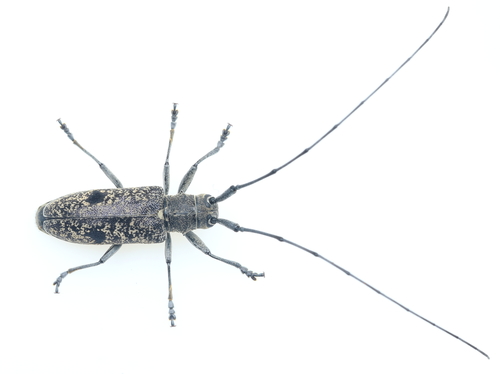
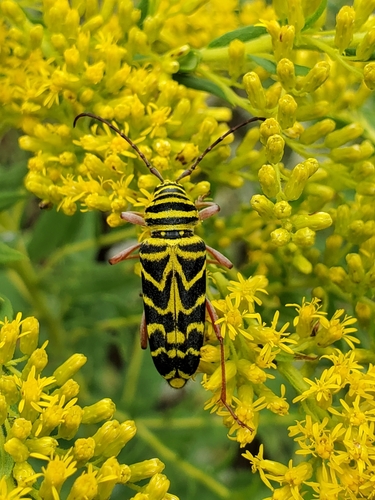
Megacyllene robiniae is a beetle species that, when viewed from a distance, is easily mistaken for a wasp or bee due to its distinctive black and yellow striped pattern. It can also be confused for two of its close relatives: Megacyllene caryae and Megacyllene decora. Adult M. robiniae beetles measure 11 to 28 mm (0.43 to 1.10 inches) in length, and have a W-shaped third stripe on their elytra. Antennae of both sexes range in color from dark brown to black. Male antennae reach two-thirds of the beetle's total body length, while female antennae reach one-half of the body length. The beetle's legs are reddish brown. Fully grown larvae are robust, legless, and white, reaching approximately 25 mm (0.98 inches) in length.
As the use of black locust (Robinia pseudoacacia) as an ornamental tree has increased, the range of M. robiniae has expanded alongside the tree's growing range. Despite this expansion, the species remains restricted to North America, and has not been recorded on any other continent where black locust has been introduced. This beetle can be found in nearly any location where unprotected black locust trees grow, and it is often more abundant in areas where Solidago, commonly known as goldenrod, is also present. Adult M. robiniae feed on goldenrod pollen, and due to this floral preference, they tend to remain in uncultivated fields and meadows.
In fall, females can typically be found running up and down black locust trunks searching for tree wounds to lay their eggs in. Both sexes of M. robiniae are most commonly active from late afternoon through dusk. Adults feed on pollen from goldenrod plants of the genus Solidago. Females lay their eggs in bark crevices and near wounds on black locust trunks. After hatching, larvae overwinter in hibernation inside the tree's bark. Once winter ends, the larvae burrow into the tree trunk and create feeding tunnels. These tunnels measure around 10 cm (3.9 in) long by 7 mm (0.28 in) wide, and act as primary infection sites for wind-borne spores of the fungus Fulvifomes robiniae. This fungus causes damaging heart rot in Robinia tree species, making infected trees far more susceptible to wind damage. Larvae overwinter inside the host tree before pupating in late July and early August. Adults begin emerging in late August and continue emerging through September, and are generally active from August through October.