About Megachile erythropyga Smith, 1853
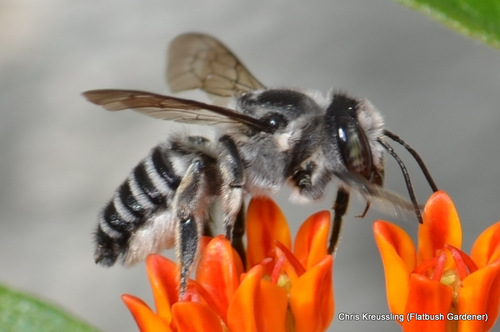
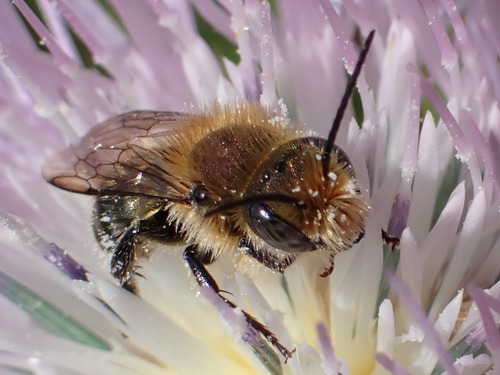
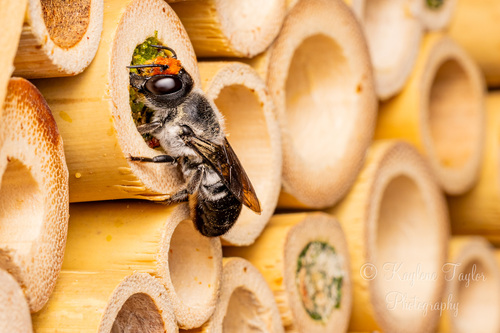
Megachile erythropyga Smith, 1853 is a leafcutter bee species. Males grow to around 10 mm in length, while females are larger, reaching around 14 mm long. Both sexes have bright orange facial hair, plus an orange patch of hair at the tip of the abdomen. The first abdominal segment has long white hair, and a small patch of white hair appears on each side of the second abdominal segment. Wings are smoky in color with black veins. Females have very pale yellow scopal hairs, used to collect pollen, located underneath the abdomen. Males of this species lack the modified forelegs seen in males of many other Megachile species. This species is distributed across southern Australia, occurring in the states of Western Australia, South Australia, Victoria, New South Wales, and Tasmania. It can be found in both bushland and urban areas. Female M. erythropyga nest in narrow cavities, including beetle borer holes in dead wood. They will also use pre-existing man-made holes, such as hose reel bolt holes and cavities in bee hotels. In a study of bee hotel use in southwest Western Australia, this was the most frequently recorded species. Nests are built in cavities between 5 mm and 8 mm in diameter. Females use resin to construct separate individual cells inside the nest cavity. They lay one egg per cell, and stock each cell with a mix of pollen and nectar to feed the developing larva until it pupates. Research conducted in Victoria using paper straw bee hotels found that nests contain between 3 and 9 cells, with an average of approximately 5 cells per nest. The entire nest is sealed with a resin plug, which sometimes includes additional materials such as sand, wood drillings, grass, or small pieces of leaf. Nests are often at risk of invasion by wasps of the genus Gasteruption, but female M. erythropyga have been observed fighting and evicting these invading wasps from their nesting cavities. This species is polylectic, meaning it collects pollen from a wide range of flower types. It has been observed visiting flowers from the genera Lotus, Cullen, Eucalyptus, and Melaleuca. Adult M. erythropyga have a lifespan of approximately six weeks.