About Megachile campanulae (Robertson, 1903)
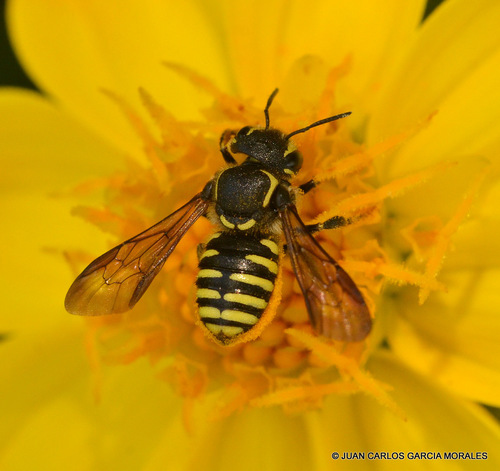
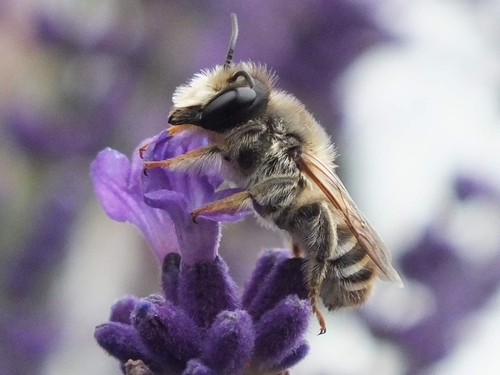
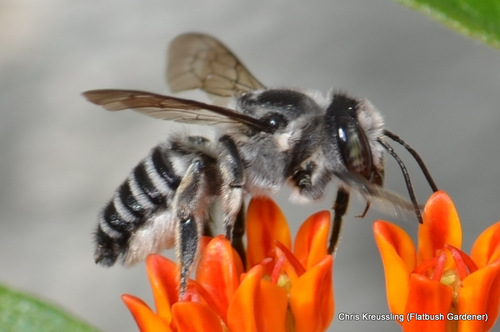
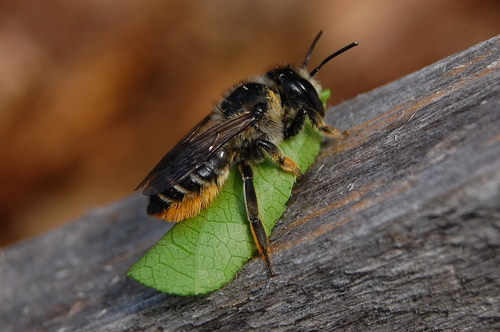
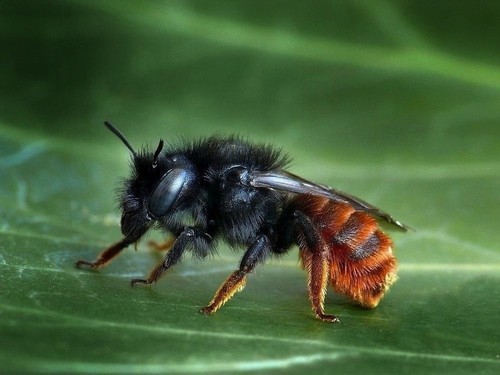
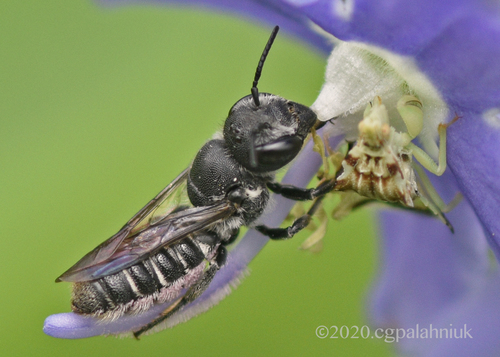
Megachile campanulae is a species of bee described by Robertson in 1903. These are medium-sized bees with three distinct anatomical body regions: a head, a middle mesosoma, and a posterior metasoma. The mesosoma forms when the thorax fuses with the first abdominal segment, also called the propodeum. Like many other insects, they have both compound eyes and simple eyes known as ocelli. Males are smaller than females. This species is a resin-gathering bee, and its mandibles characteristically lack the cutting edges that are present in the closely related leafcutter bees. Fine short hairs called pubescence cover different parts of the body, and the hairs vary in length, texture, and color across different body regions between males and females. Morphologically, Megachile campanulae most closely resembles Megachile angelarum, and it also shares marked appearance similarities with Megachile exilis. Male Megachile exilis have characteristically dilated, hollowed-out front tarsal leg segments, while the tarsi of M. campanulae are unmodified and unremarkable. The species has a broad native range across eastern North America. It is native to southern Ontario, Canada, with its range extending from this southeastern Canadian province through the New England states down to Florida. To the west, its range reaches as far as Minnesota, Nebraska, and Texas. There are a few documented sightings further west, including confirmed presence in Colorado and Montana. Megachile campanulae is a member of the subgenus Chelostomoides, making it a type of mason bee. As mason bees, they use plant resins, mud, and pebbles to construct their nests. Females typically build small nests in pre-existing holes found in trees, fences, or plant stems, and they will also nest in artificial nest-traps or bee-blocks. Nests are built as a single long column of cells along the length of a tunnel or tube. Females construct the deepest cells first, then lay one egg sequentially in each new cell. Cells are partitioned and sealed using a combination of the collected construction materials. Each cell is provisioned with pollen, sometimes mixed with nectar, to nourish hatching larvae. This species is polylectic, so larvae are fed pollen from a wide variety of plant sources. After passing through several molting stages, larvae spin cocoons and enter the pupal stage, then overwinter as pupae. After several months, adult bees emerge from the cocoons. Males usually emerge earlier than females, and die shortly after mating. Females survive for several additional weeks, during which they build new nests and gather nest provisions. Across most of the species' range, adult bees are active from April to September. In Florida, specimens have been collected as early as February and as late as November. In the cooler climates within the species' range, typical flight activity occurs from May to October. Megachile campanulae is a solitary bee that does not form colonies; unlike social insects such as ants, yellow jackets, and honeybees, resin bees and leafcutter bees work independently to build their nests. Similar to honeybees, female M. campanulae perform nearly all essential tasks related to brood rearing. While this species does not produce honey, it provides an important ecosystem service by pollinating both crops and wild plants. Although females can deliver a mild sting that is less intense than a honeybee sting, the species is considered nonaggressive. Bees in the family Megachilidae carry pollen on the underside of the abdomen, and unlike honeybees, they do not have pollen baskets on their hind legs. Most bees in the genus Megachile are small to medium-sized, though Megachile pluto, which reaches 38 mm in length, is regarded as the largest bee in the world. Many species in this genus are commonly called leafcutters. Because M. campanulae lacks mandibular cutting edges, it belongs to the resin- or mud-using subgenus Chelostomoides instead. Megachile bees in general pollinate a broad array of flowering plants from many different families. Documented plant species pollinated by Megachile campanulae include: Asclepias (milkweed), Baptisia (wild indigo), Campanula (bellflower), Galactia (wild peas), Malva (mallow), Melilotus (sweet-clover), Oenothera (evening primrose), Lobelia (lobelias), Lythrum (loosestrife), Nepeta (catmints), Pontederia (pickerel weeds), Psoralea (white tumbleweed), Pycnanthemum (mountain mints), Rudbeckia (coneflowers, black-eyed-susans), Solidago (goldenrods), Strophostyles (trailing wild bean), Symphoricarpos (snowberry, also called waxberry or ghostberry), and Verbena (verbena or vervain).