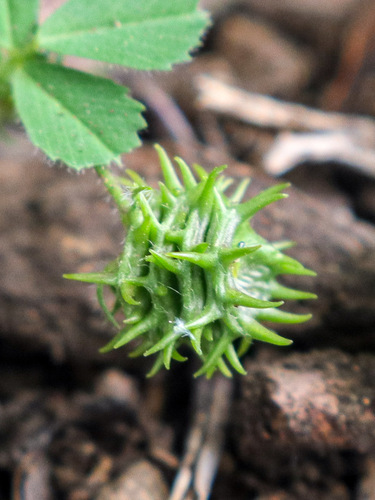
About Medicago truncatula Gaertn.
Medicago truncatula, commonly called barrelclover, strong-spined medick, barrel medic, or barrel medick, is a small annual legume that is native to the Mediterranean region and widely used in genomic research. It is a low-growing, clover-like plant that reaches 10–60 centimetres (3.9–23.6 in) in height, with trifoliate leaves. Each leaflet is rounded, measures 1–2 centimetres (0.39–0.79 in) long, and often has a dark spot at its center. Its flowers are yellow, and are produced either singly or in small inflorescences holding two to five flowers; its fruit is a small, spiny pod. This species is studied as a model organism for legume biology, for multiple reasons: it has a small diploid genome, is self-fertile, has a rapid generation time and prolific seed output, can undergo genetic transformation easily, and its full genome has been sequenced. It forms symbiotic relationships with nitrogen-fixing rhizobia (specifically Sinorhizobium meliloti and Sinorhizobium medicae) and arbuscular mycorrhizal fungi, including Rhizophagus irregularis, which was previously named Glomus intraradices. The common model plant Arabidopsis thaliana does not form either of these symbioses, which makes M. truncatula a valuable tool for studying these symbiotic processes. It is also an important forage crop species in Australia.