About Medicago rigidula (L.) All.
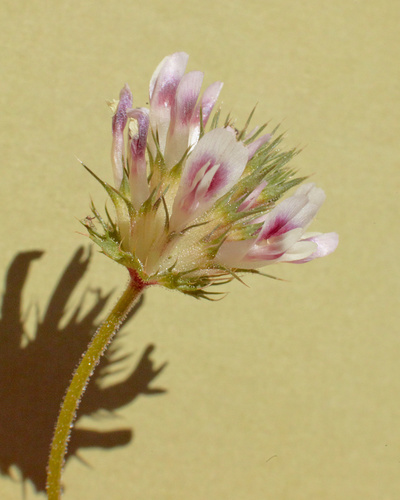
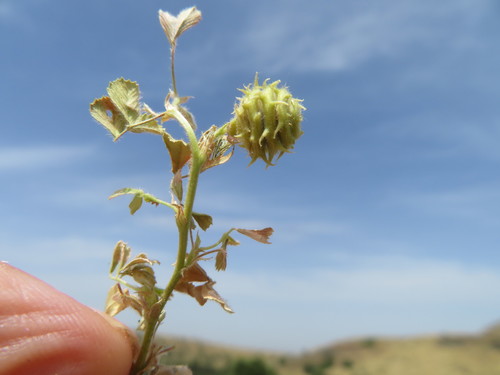
Medicago rigidula (L.) All., commonly known as Tifton burclover, is an annual herb species in the family Fabaceae. It has a self-supporting growth form, compound broad leaves, and can reach up to 0.50 meters in height. It is a secondary wild relative of the cultivated crop barrel clover (Medicago truncatula), and a tertiary wild relative of cultivated alfalfa (Medicago sativa).
This species has a widespread distribution, growing at elevations ranging from sea level to 1,800 meters above sea level. It is native to Albania, Algeria, the Balearic Islands, Bulgaria, Corsica, Egypt, France, Greece, Italy, Crete, Crimea, Lebanon-Syria, Libya, Morocco, Palestine, Portugal, Romania, Sardinia, Sicily, South European Russia, Spain, Tunisia, Turkey, Turkmenistan, Ukraine, and Yugoslavia. It has also been introduced to California, Czechoslovakia, Great Britain, and Hungary.
It occurs in terrestrial ecosystems, including habitats such as temperate forests, grasslands, Mediterranean-type shrublands, and rocky areas like inland cliffs and mountain peaks. It can also be found growing artificially in pastures, as it is sometimes cultivated as a forage crop.
Thyme, a dominant aromatic shrub, influences the competitive status of two subsidiary plant species: Medicago minima and Medicago rigidula. When grown alone with no competitors, M. rigidula survives better in soil that contained thyme than in soil with no thyme. This differs from its relative M. minima, which survives equally well in soil both with and without thyme. M. rigidula grown on soil without thyme has higher biomass than M. rigidula grown on soil with thyme.
M. rigidula is an annual species, and its flowers bloom in March and April.
Saponins produced by Medicago species are currently studied by pharmaceutical companies, because they are effective against fungal growth and tumorigenesis. These saponins have also been found to be toxic to bacteria and certain viruses. M. rigidula plants have been recorded to have higher saponin concentrations than other Medicago species.