About Medicago lupulina L.
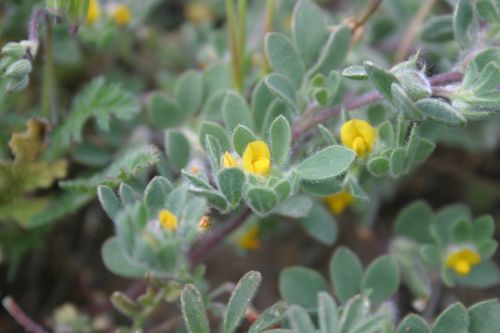
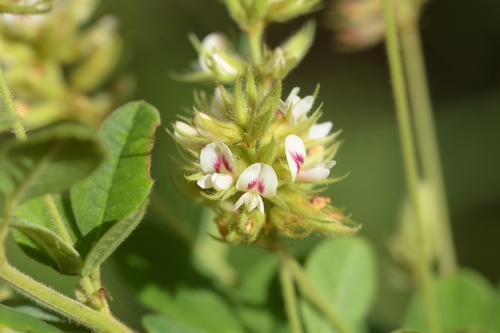
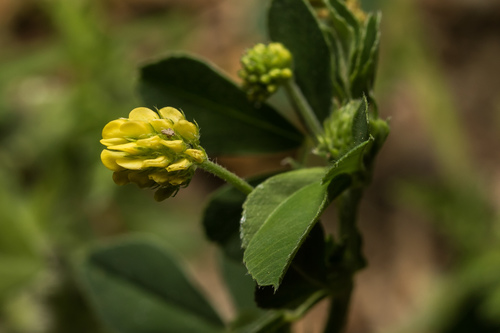
Medicago lupulina L., commonly known as black medick, is an annual or short-lived perennial plant that regrows each year from adventitious buds on its roots. Mature plants reach 15 to 80 cm (6 to 31 inches) in height, with fine stems that often lie flat during early growth before becoming erect. Its leaves are compound, with three oval leaflets each borne on a short petiole; the central leaflet typically has a longer petiole than the others. The leaflets are hairy, toothed near the tip, and end in a short point, which distinguishes them from the leaflets of the similar species Trifolium dubium. Black medick produces small yellow flowers 2–3 mm long, grouped into tight bunches called compact racemes. On larger plants, these flower heads can reach 8 mm (5⁄16 inch) or more in size. The fruit is a single-seeded pod, 1.5 to 3 mm in diameter, that does not open when it matures; instead, it hardens and turns black as it ripens. Each pod holds a single amber-colored seed. Like other legumes, black medick roots have nodules that host nitrogen-fixing bacteria. Plants that live more than one year may develop a deep tap root. Black medick is native to the Old World, where it occurs across all of Europe, north Africa, the Near East, and most of Asia including India, China, and Korea. It has become naturalized in central Asia, Japan, South Africa, Australia, New Zealand, the United States, Canada, and much of South America. It is found across the entire United States, including Hawaii and Alaska. Black medick grows best in dry to moist, well-drained soils that contain sand, loam, or clay. It is a pioneer plant that often grows on disturbed ground, and tolerates alkaline, neutral, and mildly acidic conditions. It will not grow in shady areas. It grows well in limestone soils and on coastal sand dunes, where it faces less competition from other plants, so it occurs on many islands including Taiwan, the Canary Islands, the Azores, and Madeira. It is resistant to cold and can be found on mountains up to 1,800 meters in elevation. Black medick is a good source of nectar for bees to make honey. It is frequently found in natural pastures, and may be planted to create artificial meadows, particularly on dry land. Large concentrations of black medick as a lawn weed often indicate that the soil has low nitrogen content. Because black medick and other clovers fix atmospheric nitrogen in the soil, this nitrogen deficiency can improve over time with these plants growing in the area. Black medick is sometimes used as a fodder plant. Its hardiness, ability to grow in poor soils, and nitrogen fixation make it a good option for pasturage, though its overall fodder value is limited. It is grazed by sheep, but is not very palatable to cattle.