About Medeola virginiana L.
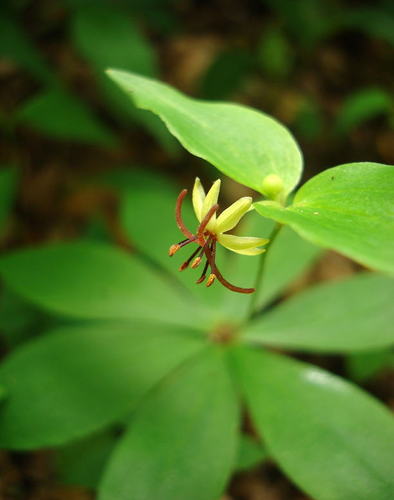
Medeola virginiana, commonly known as Indian cucumber-root, produces shoots that have two tiers of whorled leaves. The lower tier usually holds between five and nine lance-shaped leaves, occasionally as many as 12. The upper tier holds three to five ovate leaves. All leaves have smooth, entire margins. Some individual plants do not develop a second tier of whorled leaves; the second tier only grows when the plant produces flowers. When a plant develops both tiers, it reaches a height of 30 inches (76 centimeters). The plant's flowers have yellowish green tepals and emerge in late spring. Its fruit is a dark blue to purple, inedible berry that sits above the top tier of leaves. Indian cucumber-root shoots grow each spring from an overwintering tuber-like structure. This structure produces a series of horizontal rhizomes that grow at 45-degree angles, forming a clonal colony of plants arranged in an octagonal pattern. Medeola virginiana ranges in distribution from Ontario to Nova Scotia, south to Florida and Louisiana. It grows in rich, moist forests, thickets, and woodlands. It is classified as an endangered plant in both Florida and Illinois. This species produces a crisp, edible tuber that smells and tastes like garden cucumber; the tuber can be washed and eaten either raw or cooked. The Iroquois people used this plant as an anticonvulsant and a pediatric aid.