About Mecocerculus poecilocercus (P.L.Sclater & Salvin, 1873)
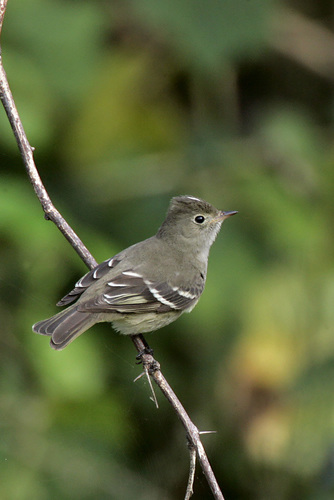
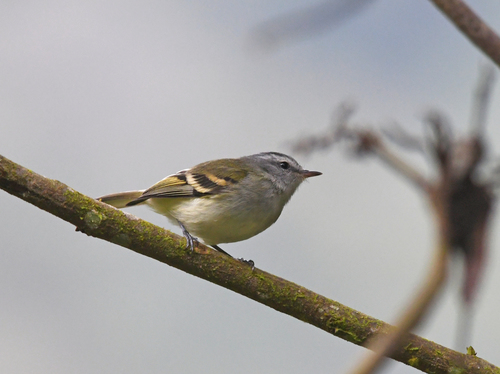
The white-tailed tyrannulet (scientific name Mecocerculus poecilocercus, first described by P.L. Sclater and Salvin in 1873) measures about 11 cm (4.3 in) long and weighs 10 to 11 g (0.35 to 0.39 oz). Both sexes share the same plumage. Adult individuals have a medium gray crown, a thin white supercilium, and a faint blackish stripe running through the eye, with the rest of the face being whitish. Their upperparts are mostly greenish olive, with a bright greenish yellow rump and uppertail coverts. Their wings are dusky, with pale yellow edges along the flight feathers; the wing coverts have white to pale buff tips that form two distinct bars when the wing is closed. Their tail is dusky olive, with the outermost pair of feathers being mostly to fully white. Their throat is grayish white, their breast and sides are grayish white with a darker grayish wash, and their belly and undertail coverts are yellowish white. Both sexes have a brown iris, a thin, pointed black bill, and medium gray legs and feet.
The white-tailed tyrannulet is distributed across the Andes, ranging from northern Colombia southward along both slopes through Ecuador and into Peru. On Peru's west slope, it occurs only in Piura Department, while on the east slope it extends as far as Cuzco Department. It inhabits humid subtropical montane evergreen forest, particularly moss-rich cloudforest. Its elevation range is 1,800 to 2,800 m (5,900 to 9,200 ft) in Colombia, 1,500 to 2,500 m (4,900 to 8,200 ft) in Ecuador, and 1,450 to 2,700 m (4,800 to 8,900 ft) in Peru.