About Mecocerculus leucophrys (Orbigny & Lafresnaye, 1837)
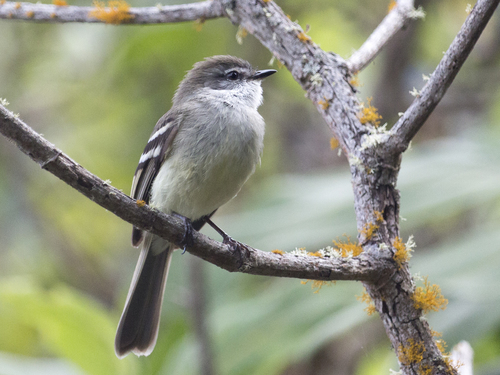
The white-throated tyrannulet, Mecocerculus leucophrys (Orbigny & Lafresnaye, 1837), is 11 to 14 cm (4.3 to 5.5 in) long. Both sexes share identical plumage. Adults of the nominate subspecies M. l. leucophrys have a dark olive-gray crown and nape. They have white lores, a thin white supercilium, and an otherwise dusky face with some white on the ear coverts. Their upperparts are medium olive-gray. Their wings are brownish black, with cinnamon-buff to yellowish buff edges and tips on the flight feathers. Cinnamon-buff tips on the wing coverts form two wide bars on the closed wing. Their tail is dusky brown. Their puffy white throat extends past the ear coverts. They have a vest-shaped gray band across the breast, and the rest of their underparts are medium yellow. Both sexes of all subspecies have a dark brown iris, a long black bill, and black legs and feet. The species' other subspecies differ from the nominate subspecies and from each other as follows: M. l. montensis is smaller than the nominate, with brownish upperparts and nearly white wingbars and flight feather edges. M. l. chapmani is smaller than the nominate, with darker brownish (less olive-gray) upperparts, a strong olive breast band, and a richer yellow belly. M. l. nigriceps is smaller than the nominate, with a more olive crown and back and nearly white wingbars and flight feather edges. M. l. notatus is larger than the nominate, with more brownish upperparts, rich cinnamon-buff wingbars and flight feather edges, and a slightly browner breast band. M. l. setophagoides is larger than the nominate, with more brownish gray upperparts, paler wingbars, and a paler, creamy yellow belly. M. l. parui is smaller than the nominate, with darker brownish (less olive-gray) upperparts. M. l. rufomarginatus has a dark sepia-brown crown, warmer and richer brown upperparts than the nominate with rich rufous wingbars and flight feather edges, a warm brown wash on the breast band and flanks, and a paler yellow belly. M. l. roraimae is smaller than the nominate, with much darker crown and upperparts and more ochraceous wingbars. M. l. brunneomarginatus has a dark sepia-brown crown, warmer and richer brown upperparts than the nominate with medium rufous wingbars and flight feather edges, and a warm brown wash on the breast band and flanks. M. l. pallidior has paler, more grayish brown upperparts, wings, tail, and breast band. The subspecies of the white-throated tyrannulet have the following ranges: M. l. montensis is found in Sierra Nevada de Santa Marta in northern Colombia. M. l. chapmani occurs on Cerro Duida and Cerro Marahuaca in Venezuela's central Amazonas state. M. l. nigriceps is found in Colombia's Santa Marta region and in northern Venezuela from Yaracuy east to Sucre and Monagas states. M. l. notatus ranges through Colombia's Western and Central Andes south to Cauca Department. M. l. setophagoides occurs in the Eastern Andes of Colombia between Norte de Santander and Cundinamarca departments, the Andes of northwestern Venezuela between Táchira and Lara states, and Serranía del Perijá on the Colombia-Venezuela border. M. l. parui is found on Cerro Parú in Venezuela's north-central Amazonas. M. l. rufomarginatus ranges along the Andes from Nariño Department in southwestern Colombia south through Ecuador into northwestern Peru's Department of Piura. M. l. roraimae occurs on the tepuis of Venezuela's Amazonas and Bolívar states (excluding the areas occupied by chapmani and parui), extreme northern Brazil, and western Guyana. M. l. brunneomarginatus is found in the eastern Andes of Peru south to Cuzco Department. M. l. pallidior occurs in the western Andes of Peru in Ancash and northern Lima departments. The nominate subspecies M. l. leucophrys ranges along the eastern Andes from southern Peru's Cuzco and Madre de Dios departments south into northern Argentina as far as La Rioja Province. The white-throated tyrannulet lives in a variety of temperate landscapes in the Andes and other mountains, including the interior and edges of humid montane forest, stunted cloudforest, elfin forest, Polylepis woodland, and clearings and pastures with abundant shrubs. Its elevation range is 2,500 to 3,600 m (8,200 to 11,800 ft) in Colombia, mostly 2,800 to 3,500 m (9,200 to 11,500 ft) in Ecuador, 1,800 to 4,600 m (5,900 to 15,100 ft) in Peru, 1,350 to 3,700 m (4,400 to 12,100 ft) in western Venezuela, 1,300 to 2,450 m (4,300 to 8,000 ft) in eastern Venezuela, and mostly above 1,300 m (4,300 ft) in Brazil.