About Maxillaria tenuifolia Lindl.
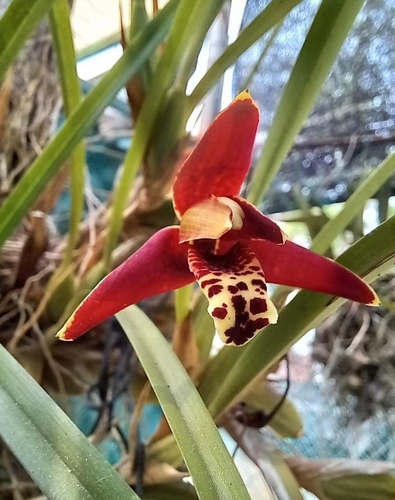
Maxillaria tenuifolia, commonly called the delicate-leafed maxillaria or coconut pie orchid, is an orchid species native to the region from Mexico to Nicaragua, and possibly also grows in Costa Rica. Among all species in the genus Maxillaria, which are generally not highly sought after for cultivation, Maxillaria tenuifolia is the most popular. This popularity comes from the scent of its flowers, which strongly resembles that of coconuts. Its flowers are relatively small, typically no larger than one and a half inches across, and only one flower grows per spike. The flowers are red, with speckles in yellow or brown. This orchid is easy to grow and bloom, but it prefers slightly cooler nighttime temperatures during winter. It grows best in medium light conditions, with light levels between those preferred by Cattleya and Phalaenopsis orchids. 1500 to 3500 foot candles is the ideal light range. It also grows well under fluorescent or high pressure sodium grow lights. It thrives in intermediate temperatures: winter nights should range from 55 to 62 degrees Fahrenheit, and winter days should range from 58 to 75 degrees Fahrenheit. Summer temperatures can be several degrees warmer than this range. This orchid requires a relative humidity of 50 percent or higher. In dry indoor conditions, using humidity trays or room humidifiers to add extra humidity benefits the plants. In its natural habitat, this species receives abundant water during the rainy season, followed by a dry season that runs from December to May. For indoor cultivation, this means the potting medium should be allowed to dry out between waterings from late November to the end of March. You must take care not to let the pseudobulbs become excessively wrinkled, so the plant should not be kept too dry. During this dry winter period, plants typically only need watering every 2 to 3 weeks. Around mid-March, you can resume a normal watering schedule, where the potting medium is allowed to become somewhat dry between waterings, but not as dry as it is during winter. Rainwater, distilled water, or reverse osmosis water are the best choices for watering this orchid. These plants are easy to grow when kept moist, provided with good air movement, and placed on a high-light windowsill of any orientation except north-facing.