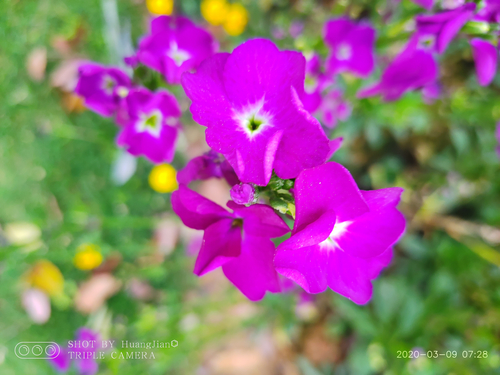
About Matthiola incana (L.) W.T.Aiton
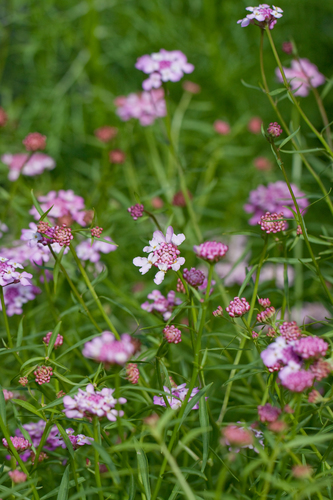
Description: Some varieties of Matthiola incana, known as 'ten-week stocks', are grown as annuals. These annual plants reach 20 to 28 centimeters in height, with woody bases that have many leaf scars and branches ending in terminal leaf rosettes. The entire plant is covered in star-shaped whitish hairs. Leaves can be entire or slightly wavy, are lanceolate, and taper to a short petiole; they have a rounded shape and an ash-grey color. The flowers are fragrant, and come in shades of white, cream yellow, pink, red, purple, or blue; they are held on a 10–20 mm (0.39–0.79 in) stalk. The scar flaps on the back of the flower are swollen. The seed pods are compressed, with flattened flaps. Pedicels measure 10–12 mm (0.39–0.47 in) when the plant is in flower, and grow to 12–17 mm (0.47–0.67 in) when fruiting, with an erect-spreading orientation. Sepals are around 11–14 mm (0.43–0.55 in) long, with a narrow thin dry margin, are not prominent, and are green or slightly purple. Petals are 25–30 mm (0.98–1.18 in) long, with a claw (narrow basal portion) almost as long as the petal blade, and range in color from white, pink, violet to purple. Seeds are 2–3 mm across, are nearly round, and have a whitish wing.
Distribution: Matthiola incana is native to southern Europe, ranging from Spain to Greece. It is naturalized in the western Mediterranean region, growing in roughly the same area as the olive tree. It prefers calcareous soils, and often grows on sea-facing cliffs or old walls. It is primarily a coastal plant, but can also be found naturalized in inland areas up to 600 m (1,970 ft) elevation.