About Masticophis taeniatus (Hallowell, 1852)
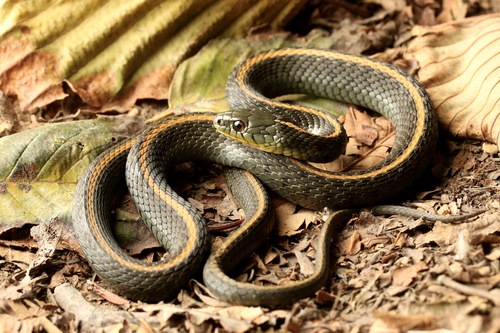
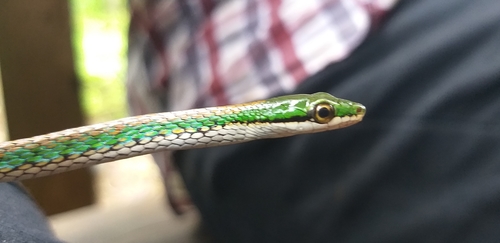
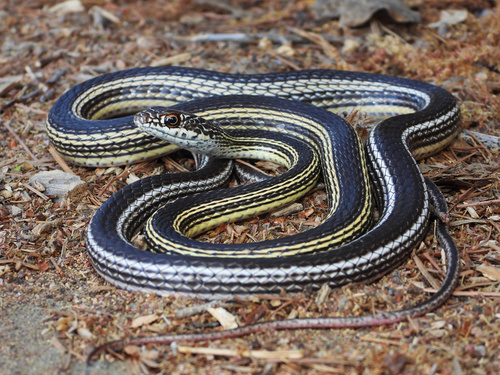
The striped whipsnake, scientifically named Masticophis taeniatus (Hallowell, 1852), has a total length (including the tail) of approximately 30 to 72 inches, which equals 76 to 183 cm. Its back is colored black, dark brown, or gray, and often carries an olive or bluish tint. A dark longitudinal stripe runs along the center of each of the first four rows of pale dorsal scales. The snake has a white to cream-colored stripe running down its side, which is split in the middle by either a solid or dashed black line. Its belly is typically cream to yellowish, fading to white closer to the head and turning coral pink toward the tail. This species has a lower preocular scale positioned between the upper labial scales of the mouth, and its anal scale is divided. The striped whipsnake occurs across the western United States and northern Mexico. Its range extends north to south-central Washington, then south into the Great Basin between the Cascade-Sierran crest and the Continental Divide. From there, it continues southeast across the Continental Divide into New Mexico, and western and central Texas. The southern edge of its range reaches Michoacán, Mexico. In the western United States, its range extends outside the Great Basin into the Rogue River Valley in southwestern Oregon and northern California, and a population exists in Bryce Canyon National Park, Utah. The striped whipsnake is commonly found in a wide range of habitat types, including shrublands, grasslands, sagebrush flats, canyons, piñon-juniper woodlands, and open pine-oak forests. It is drawn to both permanent and seasonal rocky streams, and lives in both flatlands and mountain areas. This species is oviparous, and little is known about its overall reproductive behavior. After fertilization, females lay a clutch of 3 to 12 eggs between June and July, usually in an abandoned rodent burrow. One recorded study found that the natural incubation period for eggs ranges from 44 to 58 days.