About Masticophis fuliginosus (Cope, 1895)
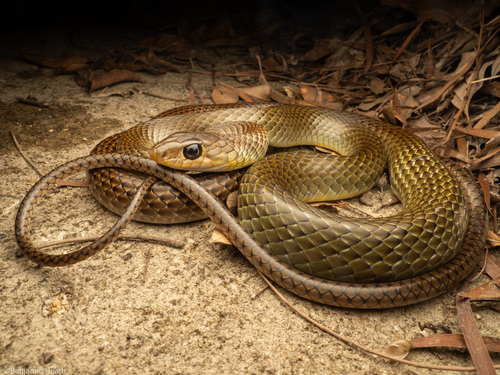
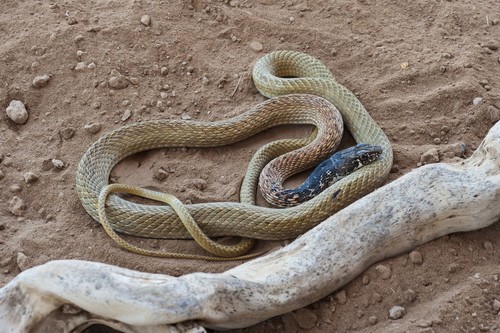
Masticophis fuliginosus, commonly known as the Baja California coachwhip, is a large, fast-moving snake species. Adults typically reach total lengths between 2 and 4.3 feet, or 24 to 52 inches. This species has several distinct color morphs, some of which are only found in specific geographic regions. All-black sleek coloration occurs across the species' entire range. Another common morph is dull yellow with a black or brown head and neck. In the southern portions of the species' range, individuals may be light grayish-white with a black or brown head and neck. The underbelly is light yellow to white in all color morphs. In California, only the black and yellow morphs have been recorded, while all morphs can be found along the Baja California peninsula. All morphs across the range can show varying degrees of mottling on the body. The body structure of the Baja California coachwhip is very similar to its close relative, the coachwhip Masticophis flagellum. Both species share large forward-facing eyes that support strong vision and depth perception, a slender body build, and a long, tapering tail. Both also have large scales above the eyes, and tail scales with a distinct braided appearance. This tail appearance resembles a braided horsewhip, which is the source of the common "coachwhip" name shared by both species. The range of the Baja California coachwhip extends from the southernmost part of San Diego County in California, through the entire Baja California peninsula, to the area around Cabo San Lucas. The species is also found on multiple islands in the Gulf of California, as well as along the Pacific coast of the Baja California peninsula. It occupies elevations from 0 to 8250 feet (0 to 2515 meters), and lives in a wide variety of open habitats including coastal sand dunes, inland grasslands, scrublands, riparian environments, and agricultural areas. In the northernmost portion of its range in California, the Baja California coachwhip occurs alongside Masticophis flagellum, and the two species may intergrade. Across its full range, the Baja California coachwhip also shares habitat with other species in the Masticophis genus: the California whipsnake (Masticophis lateralis), the Baja California striped whipsnake (Masticophis aurigulus), and the Espiritu Santo striped whipsnake (Masticophis barbouri). Reproduction for this species takes place in spring. Mating has been observed in late April in northern Baja California. Females are oviparous, meaning they lay eggs. Eggs of this species have been recorded in early summer, specifically in early August.