About Massonia depressa Houtt.
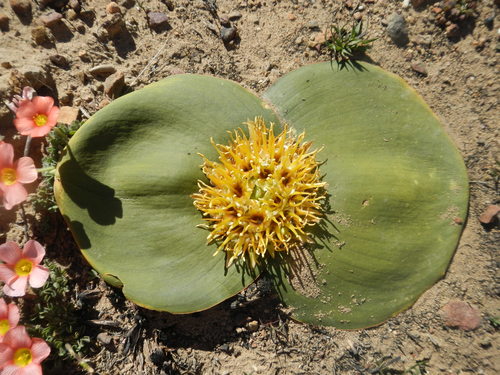
Massonia depressa, commonly called the hedgehog lily, is a flowering plant species belonging to the family Asparagaceae. It is a bulbous geophyte native to the Cape Provinces and Free State of South Africa. It reaches 10 cm (3.9 in) in height and 50 cm (20 in) in breadth, and is a bulbous perennial that produces two opposite leaves that lie flat against the ground. In winter, a spiky cluster of white, yellow, or brown flowers grows at the center of the plant. These flowers have a distinctive yeast-like scent, which evolved to attract gerbils and other rodents as pollinators. Its anther is exceptionally long, growing up to 2 mm. The seed capsules of this plant are inflated, a trait that allows the seeds to be carried by wind. Wild populations of this species have been observed to be variable. Many attempts have been made to clarify the true relationships of this species within the genus Massonia, and none of these attempts have been successful to date. The Latin specific epithet depressa translates to "having a flattened appearance", which is a characteristic shared by all species in this genus. When cultivated in temperate climates, M. depressa cannot tolerate freezing temperatures, so it must be grown under cover in a cold greenhouse or similar protected environment. It needs full sun and dry conditions during its dormant season, which begins in spring. This species has received the Royal Horticultural Society's Award of Garden Merit.