About Masdevallia veitchiana Rchb.f.
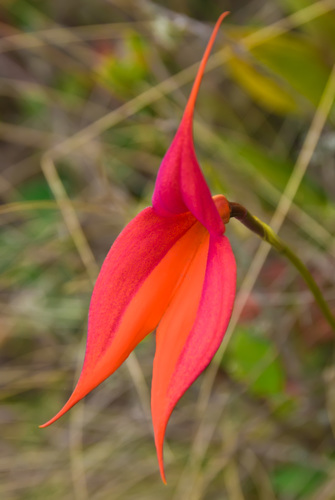
Masdevallia veitchiana Rchb.f. is a large tufted orchid species that grows in cool to cold conditions. It is most often terrestrial, sometimes grows as a lithophyte, and very rarely grows as an epiphyte. It produces erect leaves, with short ramicauls wrapped in a series of tubular bracts. Each leaf is linear-oblanceolate, tapers to a channelled petiolate base, is acute, and has a thick texture. It is found at altitudes between 2,000 and 4,000 metres, including areas around Machu Picchu in Peru. It grows on steep rocky slopes covered with grasses and shrubs in full sun, though its leaves are protected by the surrounding grass. It blooms in spring and early summer, producing an erect, single-flowered inflorescence that is 39 to 44 cm long. The inflorescence holds two distant tubular bracts, one single inflated tubular ovate floral bract, and holds the long-lasting flower well above the leaves. The species' flowers are orange, marked with patterns formed by minute purple hairs on the sepals. These hairs give the flower a prismatic, iridescent visual effect that becomes more noticeable when the flower moves in breezes. This purple hair arrangement creates unequal visible colour distribution across the flower; when viewed head-on with light positioned behind the viewer, the flower's colour appears symmetrical. The blooms are very large, measuring approximately 5 cm by 15 cm. Masdevallia veitchiana is an excellent plant for both beginner and experienced orchid growers. It grows quickly into a full specimen plant, and looks particularly spectacular when multiple flowers bloom together, which typically happens between spring and summer. This species prefers a cool, moist location, and, like most orchids, needs good light to flower consistently. In low light conditions, its flower stems tend to be weak, which causes flowers to droop. It prefers daytime temperatures between 15 and 25 degrees Celsius, and can tolerate evening low temperatures below 5 degrees Celsius. The plants cannot survive freezing, so extra care is required during periods of severe frost or freezing temperatures.