About Martes zibellina (Linnaeus, 1758)
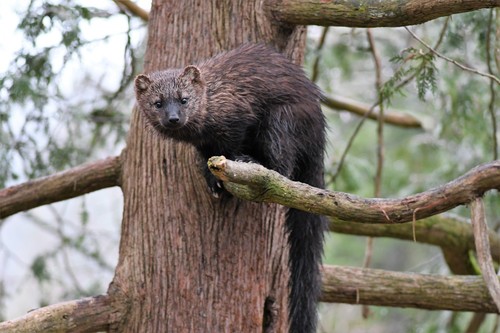
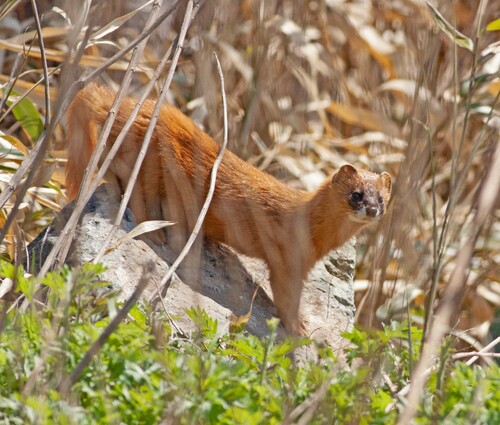
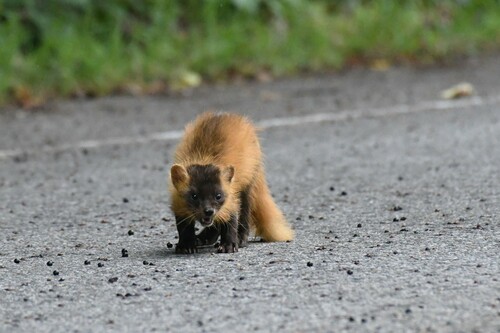
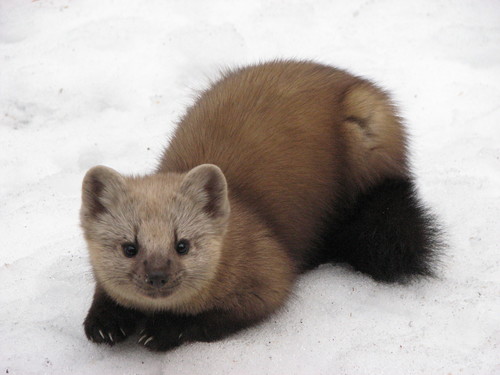
Martes zibellina (Linnaeus, 1758), commonly called sable, has distinct size differences between males and females. Males have a body length of 38–56 cm (15–22 in), a tail length of 9–12 cm (3.5–4.7 in), and weigh 880–1,800 g (31–63 oz). Females have a body length of 35–51 cm (14–20 in) and a tail length of 7.2–11.5 cm (2.8–4.5 in). The winter coat is longer and more luxurious than the summer pelage. Fur colour varies geographically between subspecies, ranging from light to dark brown, with individual sables having lighter fur on the ventral side and darker fur on the back and legs. Japanese sables specifically have black markings on their legs and feet. All individuals have a light patch of fur on the throat that can be gray, white, or pale yellow. Sable fur is softer and silkier than the fur of American martens. Sables closely resemble pine martens in size and appearance, but have more elongated heads, longer ears, and proportionately shorter tails. Their skulls are similar to pine marten skulls, but are larger, more robust, and have more arched zygomatic arches.
In Russia, the sable's current distribution is mostly the result of mass reintroduction efforts that released 19,000 animals between 1940 and 1965. Its range extends north to the tree line, south to 55–60° latitude in western Siberia, and south to 42° latitude in the mountainous areas of eastern Asia. Its western range includes the Ural Mountains, where it lives alongside the European pine marten. It is also found on Sakhalin. In Mongolia, sables live in the Altai Mountains and the surrounding forests of Lake Hovsgol; the Lake Hovsgol habitat is connected to the Trans-Baikal boreal forest region, which produces the most valuable sable pelts. In China, sables occur in a limited area of the Xinjiang Uygur Autonomous Region, and in northeastern China they are now restricted to the Greater Khingan Range. They persist in the Lesser Khingan Range in eastern Heilongjiang, and also live in Hokkaido and on the Korean peninsula.
Because sables have variable appearance across different geographic regions, there is ongoing debate about how many distinct subspecies can be clearly identified. Mammal Species of the World recognizes 17 different subspecies, but other recent academic sources have identified anywhere from seven to thirty subspecies.
Sables inhabit dense forests dominated by spruce, pine, larch, Siberian cedar, and birch, found in both lowland and mountainous terrain. The size of their home range is estimated at 4 to 30 km² (1.5 to 11.6 sq mi), varying based on local terrain and food availability. When resources are scarce, sables travel long distances to find food, with recorded travel rates of 6 to 12 km (3.7 to 7.5 mi) per day. Sables live in burrows near riverbanks and in the thickest parts of woods, and these burrows are typically dug among tree roots for extra security. They are skilled climbers of both trees and cliffs. They are primarily crepuscular, meaning they hunt during twilight hours, but become more active during the day in the mating season. Their dens are well hidden, lined with grass and shed fur, and may be temporary, especially in winter when sables travel more widely to find prey.
Sables are omnivores, and their diet changes with the seasons. In summer, they eat large numbers of mountain hare and other small mammals. In winter, when frost and snow confine them to their retreats, they feed on wild berries, rodents, hares, and even small musk deer. They also hunt stoats, small weasels, and birds. Sometimes they follow the tracks of wolves and bears to feed on the remains of their kills. They eat gastropods like slugs, rubbing slugs on the ground to remove mucus before eating them. They occasionally catch fish with their front paws and eat them. Sables hunt primarily using sound and scent, and have an acute sense of hearing. They mark their territory with scent produced by scent glands on their abdomen. Larger carnivores including wolves, foxes, wolverines, tigers, lynxes, eagles, and large owls are predators of sables.
Mating generally takes place between June and August 15, though the exact timing varies by geographic location. During courtship, sables run, jump, and make a rumbling sound similar to cats. Males dig shallow grooves up to one metre long in the snow, often urinating in these grooves. Males fight violently with each other over access to females. Females enter estrus in spring. Mating can last as long as eight hours. After insemination, the blastocyst does not immediately implant into the female's uterine wall; implantation occurs eight months later. Total gestation lasts 245 to 298 days, but actual embryonic development only takes 25–30 days. Sables give birth in tree hollows, where they build nests from moss, leaves, and dried grass. Litters have between one and seven young, with litters of two or three being most common. Males help females by defending their territories and providing food. Sable offspring are born with their eyes closed, and their skin is covered in a very thin layer of hair. Newborn cubs weigh 25 to 35 grams (0.88 to 1.23 oz) and have an average length of 10 to 12 cm (3.9 to 4.7 in). They open their eyes between 30 and 36 days after birth, and leave the nest shortly after that. At seven weeks old, the young are weaned and fed regurgitated food. They reach sexual maturity at two years of age. Sables have been recorded living up to 22 years on fur farms, and up to 18 years in the wild.
Sables can interbreed with pine martens. This interbreeding has been observed in the wild where the two species overlap in the Ural Mountains, and it is sometimes deliberately encouraged on fur farms. The resulting hybrid is called a kidus. A kidus is slightly smaller than a pure sable, has coarser fur, similar markings to a sable, and a long bushy tail. Kiduses are typically sterile, though one recorded case exists of a female kidus successfully breeding with a male pine marten.
Sable fur has been a highly valued product in the fur trade since the early Middle Ages, and is generally considered to have the most beautiful and richly coloured pelt of any marten. Sable fur is unique because it stays smooth no matter which direction it is stroked, while the fur of other animals feels rough when stroked against the grain. A wealthy 17th-century Russian diplomat once called the sable "A beast that the Ancient Greeks and Romans called the Golden Fleece." Traditionally, Russian sables were skinned through the mouth with no incision made on the body, and the feet were kept to preserve as much fur as possible. Byzantine priests wore sable fur for their rituals. In England, sable fur was held in high regard: Henry I was given a wreath of black sable by the Bishop of Lincoln that cost £100, a very large sum at the time. Sable fur was a favourite of Henry VIII, who once received five sets of sable fur valued at £400 from Emperor Charles V. Henry later ruled that only nobles of rank higher than viscount could wear sable fur. The Russian conquest of Siberia was driven largely by the presence of sables there. Ivan the Terrible once demanded an annual tribute of 30,000 sable pelts from the newly conquered Kazan Tatars, though the Tatars never sent more than 1,000, as Russia could not enforce the demand due to wars with Sweden and Poland. The best quality sable skins came from Irkutsk and Kamchatka. According to the Secret History of the Mongols, when Genghis Khan married his first wife Börte Ujin, his mother Hoelun received a coat made of sable fur from the bride's parents, which was a very high-status gift that served both aesthetic and practical purposes. Shortly after that, the young Shigi Qutuqu was identified as noble when he was found wandering a destroyed Tatar camp, because he wore a silk jerkin lined with sable.
According to Atkinson's Travels in Asiatic Russia, Barguzin on Lake Baikal was famous for its sables. The fur from this population is deep jet black with white-tipped hairs, and a single skin sometimes sold for 80 to 90 dollars to hunters. In 1916, the first nature reserve in the Russian Empire, the Barguzin Nature Reserve, was created specifically to protect and increase the population of Barguzin sable. Sable fur remained the most preferred fur in Russia until sea otters were discovered on the Kamchatka peninsula; sea otter fur was considered even more valuable. Sable furs were highly sought after by Russian Empire nobility, and very few skins left the country during that period. Some skins were privately acquired by Jewish traders, who brought them annually to the Leipzig fair. Sable hunting was sometimes assigned as work to convicts exiled to Siberia. Imperial Russian fur companies produced 25,000 sable skins annually, with almost 90 percent of the production exported to France and Germany. The civic robes of the Lord Mayor and Corporation of London, worn for State occasions, were trimmed with sable. Like minks and martens, sables were commonly caught in steel traps. Increased hunting in Russia during the 19th and early 20th century caused a severe population decline, leading to a five-year hunting ban instituted in 1935, followed by a licensed hunt restricted to winter. These restrictions, paired with the development of sable farms, allowed the species to recolonize most of its former range and reach healthy population numbers. The Soviet Union allowed Old Believer communities to keep their traditional way of life on the condition that they surrender all sable skins they produced. After the dissolution of the Soviet Union, hunting and poaching increased in the 1990s, in part because wild-caught Russian sable furs are considered the most luxurious and command the highest prices on the international market.
Currently, the full species has no special conservation status on the IUCN Red List, though the isolated Japanese subspecies M. zibellina brachyurus is listed as data-deficient. Sable fur remains highly valued and is used in various clothing items, to decorate collars, sleeves, hems, and hats, such as the shtreimel. The commonly named kolinsky sable-hair brushes used for watercolour or oil painting are not made from sable hair; they are made from the hair of the Siberian weasel.