About Martes martes (Linnaeus, 1758)
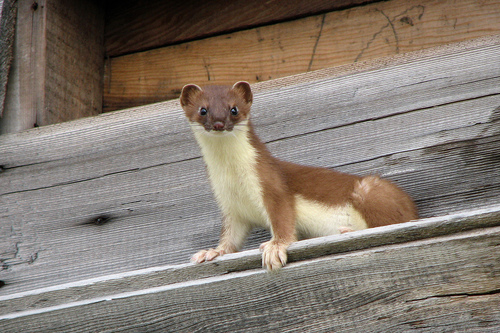
Martes martes, commonly called the European pine marten, usually has light to dark brown fur. In summer, this fur is short and coarse, while it grows longer and silkier over the winter. The species has a distinct cream to yellow-coloured "bib" marking on its throat. Adults can reach a body length of up to 53 cm (21 in), paired with a bushy tail that measures around 25 cm (9.8 in). Individuals typically weigh between 1.5–1.7 kg (3.3–3.7 lb), and males are slightly larger than females. European pine martens have excellent senses of sight, smell, and hearing.
It is the only mustelid that has semiretractable claws. This adaptation allows them to live a more arboreal lifestyle, and they are able to climb and run along tree branches; they are also relatively quick runners when moving on the ground. They are most active at night and at dusk. They have small, rounded, highly sensitive ears, and sharp teeth suited for eating small mammals, birds, insects, frogs, and carrion. They are also known to feed on berries, fruits, birds' eggs, nuts, and honey. The European pine marten is a territorial animal, and it marks its home range by depositing feces, which are black and twisted. In Ireland, the recovery of the European pine marten population is credited with reducing the population of invasive grey squirrels. Where the range of the expanding European pine marten population overlaps with the range of grey squirrels, grey squirrel populations quickly retreat, and native red squirrel populations recover. Researchers think this difference happens because grey squirrels spend more time on the ground than red squirrels, which co-evolved alongside the pine marten, so grey squirrels are far more likely to encounter this predator.