About Martes flavigula (Boddaert, 1785)
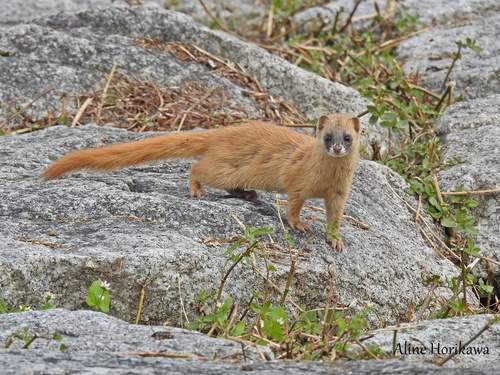
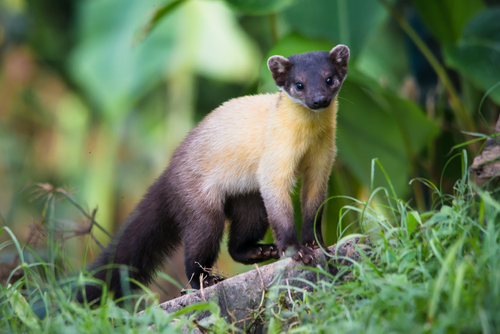
The yellow-throated marten, Martes flavigula (Boddaert, 1785), has distinct colored fur across its body: short bright brownish-yellow main fur, a blackish brown pointed head, reddish cheeks, and light brown chin and lower lips. Its chest and lower throat are orange-golden, while its flanks and belly are bright yellowish. The back of its ears is black, and the inner portions of the ears are yellowish grey. Its front paws and lower forelimbs are black. Its tail is black along the upper side, with a greyish brown base and a lighter tip. This species is robust and muscular, with an elongated thorax, long neck, and long tail that reaches approximately two-thirds the length of its body. Its limbs are relatively short and strong, with broad paws. Its ears are large and broad with rounded tips. The soles of its feet are covered in coarse, flexible hairs, but the digital and foot pads are naked, and the paws themselves are only weakly furred. Its baculum is S-shaped, with four blunt processes at the tip. It is larger than all other Old World marten species: males have a body length of 50 to 72 cm (20 to 28 in) and weigh 2.5 to 5.7 kg (5.5 to 12.6 lb), while females have a body length of 50 to 62 cm (20 to 24 in) and weigh 1.6 to 3.8 kg (3.5 to 8.4 lb). Its anal glands have two unusual protuberances that secrete a strong-smelling liquid for defense. The yellow-throated marten's range spans Afghanistan, Pakistan, the Himalayas of India, Nepal and Bhutan, continental southern China, Taiwan, the Korean Peninsula, and eastern Russia. To the south, its range extends to Bangladesh, Myanmar, Thailand, the Malay Peninsula, Laos, Cambodia, Vietnam, and the Indonesian islands of Borneo, Sumatra, and Java. It has been specifically recorded in Musk Deer National Park in Pakistan, and in northeastern India it has been reported in northern West Bengal, Arunachal Pradesh, Manipur, and Assam. In Nepal's Kanchenjunga Conservation Area, it has been recorded at elevations as high as 4,510 m (14,800 ft) in alpine meadow habitat. Yellow-throated martens hold extensive but not permanent home ranges, and actively patrol their territory, with individuals recorded covering 10 to 20 km (6.2 to 12.4 mi) over a single 24-hour period. They primarily hunt on the ground, but can climb trees proficiently and are able to jump 8 to 9 m (26 to 30 ft) between branches. After snowfalls in March, yellow-throated martens restrict all their activities to treetops. Yellow-throated marten estrus occurs twice each year: once from mid-February to late March, and again from late June to early August. During estrus periods, males fight one another to gain access to females. Litters typically have two or three kits, and only rarely have four.