About Martes americana (Turton, 1806)
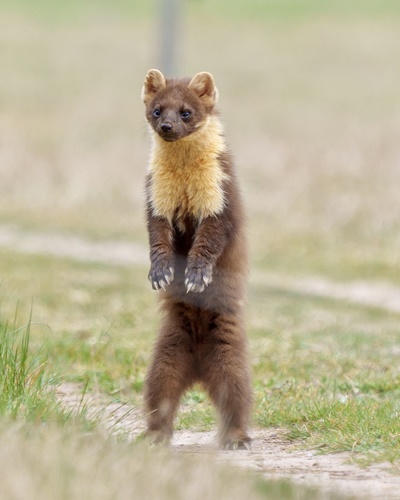
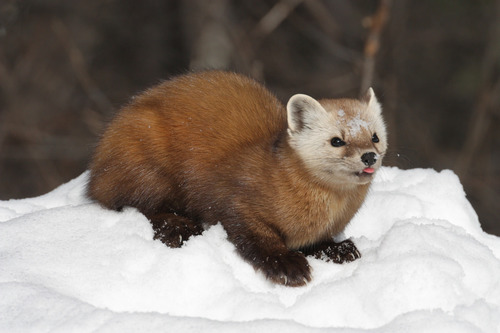
The American marten (Martes americana (Turton, 1806)) is a long, slender-bodied weasel about the size of a mink. It has relatively large rounded ears, short limbs, a bushy tail, a roughly triangular head, and a sharp nose. Its long, silky fur ranges in color from pale yellowish buff to tawny brown to almost black; the head is usually lighter than the rest of the body, while the tail and legs are darker. Individuals almost always have a characteristic pale straw to vivid orange colored bib on the throat and chest.
Sexual dimorphism is pronounced in this species. Males average about 15% larger than females in length, and can be as much as 65% larger in body weight. Total body length ranges from 1.5 to 2.2 feet (0.5–0.7 m), with tail length measuring 5.4 to 6.4 inches (135–160 mm). Adult weight ranges from 1.1 to 3.1 pounds (0.5–1.4 kg), and varies by age and location. Aside from size, males and females look very similar. American martens have limited body fat reserves, experience high mass-specific heat loss, and have low fasting endurance. During winter, individuals may enter daily shallow torpor to reduce heat loss.
The American marten has a broad distribution across northern North America. Its range extends from the northern treeline in arctic Alaska and Canada, south to New York. From east to west, it ranges from Newfoundland to western Alaska, and southwest to the Pacific coast of Canada. Its distribution is vast and continuous across Canada and Alaska. In the northeastern and midwestern United States, its distribution is restricted to mountain ranges that provide its preferred habitat. Over time, regional distribution has shifted through both contraction and expansion, with local extirpations and successful recolonizations recorded in the Great Lakes region and parts of the Northeast. The species has been reintroduced to multiple areas where it was previously extirpated, though some introductions have occurred within the existing range of the Pacific marten. It is currently considered extirpated from Pennsylvania, Maryland, Massachusetts, West Virginia, Ohio, New Jersey, and Illinois.
American martens were once thought to occupy only old conifer (evergreen) forests. Further research has found they live in young and old deciduous (leafy) forests, conifer forests, and mixed forests across Alaska, Canada, northern New England, and the Adirondacks in New York. Populations are also present in the Midwest, in the Upper Peninsula of Michigan, Wisconsin, and most of Minnesota. Trapping and forest habitat destruction have reduced population numbers, but the species is still far more abundant than the larger fisher. The Newfoundland subspecies (M. a. atrata) is classified as threatened. A broad natural hybrid zone between Pacific martens and American martens occurs in the Columbia Mountains, as well as on Kupreanof and Kuiu Islands in Alaska. Many translocations of American martens have occurred without consideration for Pacific marten conservation, putting the native Pacific marten at risk. On Dall Island, introduced American martens are hybridizing with the native Pacific marten population, which may threaten the native species. Across many islands in the Alexander Archipelago, introduced American martens are now present, and no Pacific martens have been recorded; it remains unknown whether these islands had no martens prior to introduction, or if introduced American martens extirpated the original Pacific marten populations. Genetic evidence of American marten introgression is also found in other parts of the Pacific marten's range, which is likely the result of unplanned American marten introductions. A reintroduction is currently planned for Pennsylvania, with a target completion date of 2032.
Compared to other carnivores, American marten population density is low for their body size. One review reports population densities ranging from 0.4 to 2.5 individuals per square kilometer. Population density can vary annually or seasonally, and low densities are linked to low prey abundance. American marten home range size is extremely variable, and differences are tied to sex, year, geographic area, prey availability, cover type, cover quality or availability, habitat fragmentation, reproductive status, resident status, predation, and population density. Home range size does not correlate with body size for either sex. Recorded home ranges span from 0.04 sq mi (0.1 km2) in Maine to 6.1 sq mi (15.7 km2) in Minnesota for males, and from 0.04 sq mi (0.1 km2) in Maine to 3.0 sq mi (7.7 km2) in Wisconsin for females. Males generally have larger home ranges than females; some researchers suggest this is because females have more specific habitat requirements for denning or prey that limit their ability to shift home ranges. Unusually large home ranges have been observed for four females in separate studies from Alaska and Quebec.
American martens mark their home ranges with scent. Male pelts often carry scarring on the head and shoulders, which suggests intrasexual aggression related to home range maintenance. Home range overlap is generally minimal or non-existent between adult males, but overlap can occur between males and females, between adult males and juveniles, and between females. Multiple researchers have observed that home range boundaries often align with topographical or geographical features. In south-central Alaska, home range boundaries followed creeks and a major river. In an area of interior Alaska that had burned 8 years prior to study, home range boundaries aligned with transition zones between riparian and nonriparian habitats.
American martens are opportunistic predators, and their diet is shaped by local and seasonal abundance and availability of potential prey. At rest, they require approximately 80 calories per day, which equals about three voles from the Microtus, Myodes, and Phenacomys genera. Voles make up the majority of the diet across the entire American marten range, but larger prey particularly snowshoe hares and American red squirrels can be important food sources, especially in winter. Red-backed voles (Myodes spp.) are generally consumed in proportion to their availability, while meadow voles (Microtus spp.) are consumed more often than expected given their availability in most areas. Deer mice (Peromyscus maniculatus), shrews (Soricidae), birds, and carrion are generally eaten less often than expected, but can become important food sources in areas with few alternative prey options.
American marten diet can shift seasonally or annually. Diet is generally more diverse in summer than in winter, and summer diets include more fruit, nuts, vegetation, and insects. Overall, American marten diet is more diverse across the species' distribution than Pacific marten diet, though Pacific marten populations in Pacific states also have high diet diversity. American martens have the lowest diet diversity in the subarctic; low diversity can also occur in areas where diet is dominated by large prey species such as snowshoe hares or red squirrels. American martens may act as important seed dispersers. Seeds generally pass through their digestive system intact and remain able to germinate. One study from Chichagof Island in southeast Alaska found that seeds of Alaska blueberry (Vaccinium alaskensis) and oval leaf huckleberry (V. ovalifolium) had higher germination rates after passing through an American marten's gut compared to seeds that fell naturally from the parent plant. Analyses of American marten movement and seed passage rates indicate the species can disperse seeds over long distances: 54% of the analyzed distances were greater than 0.3 miles (0.5 km).