About Marianthus bignoniaceus F.Muell.
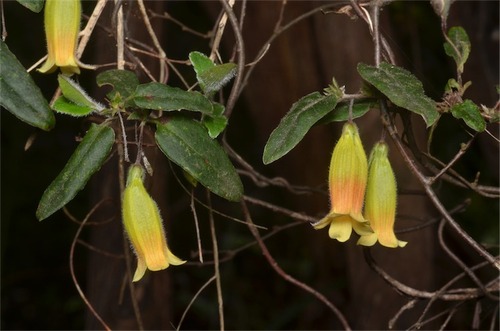
Marianthus bignoniaceus F.Muell. is a slender twining climber. Its stems are reddish brown, covered with silky hairs when young, and become hairless with age. Adult leaves are egg-shaped or narrowly egg-shaped, 12 to 50 mm long, 6 to 25 mm wide, borne on a short petiole, with scattered soft hairs on both leaf surfaces. Flowers are borne singly or in pairs on a slender, hanging pedicel 3 to 7 mm long. The sepals are lance-shaped, joined at the base, 2 to 6 mm long, and covered in shaggy hairs. The five petals are 15 to 22 mm long, joined at the base to form a bell-shaped tube that is green and orange or salmon-pink, with petal lobes 2 to 5 mm long. Flowering occurs mainly from September to January, though flowers can often be found throughout the year. This species grows in moist forest and dense scrub near streams, and sometimes grows between rocks at higher elevations. It is the only Marianthus species that occurs outside Western Australia. In Australia, it is found in Grampians National Park and the nearby Black Range in Victoria, and in and near the Mount Lofty Ranges and on Kangaroo Island in South Australia.