About Mareca strepera (Linnaeus, 1758)
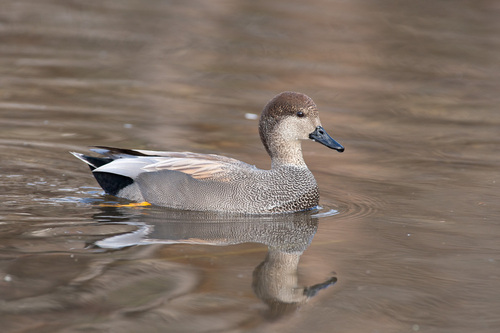
Mareca strepera, commonly known as the gadwall, measures 47–58 cm (19–23 in) in length, with a wingspan of 78–85 cm (31–33 in). Males are slightly larger than females, with an average weight of 990 g (35 oz) compared to the female average of 850 g (30 oz). Breeding males have patterned grey plumage, a black rear end, light chestnut wings, and a distinct brilliant white speculum that is visible both in flight and at rest. During non-breeding eclipse plumage, the drake more closely resembles the female, but retains the male wing pattern, is typically greyer on its upper body, and has less orange on its bill. Females are light brown, with plumage very similar to that of a female mallard. They can be told apart from female mallards by their dark bill with orange edges, smaller overall size, white speculum, and white belly. After their initial juvenile moult, both sexes undergo two moults each year. The gadwall is generally a quiet duck, except during its courtship display. Female gadwalls produce a call similar to the quack of a female mallard, but higher in pitch, often transcribed as gag-ag-ag-ag. Males produce a grunt transcribed as mep, along with a whistle. The gadwall breeds in northern Europe, across the Palearctic, and in central North America. In North America, its breeding range extends along the Saint Lawrence River, through the Great Lakes, Alberta, Saskatchewan, and the Dakotas, south to Kansas, west to California, and along coastal Pacific Canada and southern coastal Alaska. The species’ range is currently expanding into eastern North America. This strongly migratory dabbling duck winters farther south than its breeding range, from coastal Alaska south into Central America, east into Idaho, Kansas, Ohio, and Virginia, and extending all the way south into Central America. In Great Britain, the gadwall is a scarce breeding bird and winter visitor, though its population has grown in recent years. Its expansion here is thought to be partly due to intentional introductions, mainly in England, and partly due to colonization by continental birds that stay to breed in Scotland. A small breeding population has recently become established in Ireland, centered on County Wexford in the south and Lough Neagh in the north. Gadwall are also observed in parts of South Asia, particularly in southern India.