About Mareca sibilatrix (Poeppig, 1829)
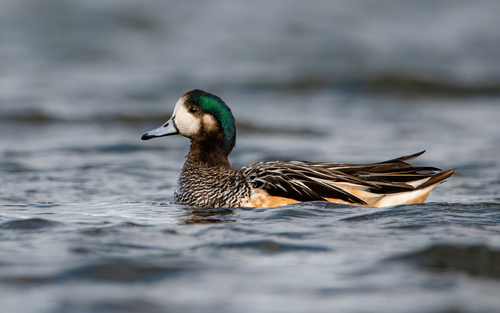
The Chiloé wigeon, scientifically named Mareca sibilatrix (Poeppig, 1829), measures 46 to 56 cm (18 to 22 in) in body length, with a 75 to 86 cm (30 to 34 in) wingspan. Its wing length is around 25 cm (9.8 in), and its average weight is approximately 800 g (28 oz). This species has an iridescent green-blue cap on its head, a bluish gray bill with a black tip, white cheeks and forehead, dark brown eyes, and a white auricular patch. The neck and occipital region of the head are black. Its breast has black and white barring, and its wing plumage is gray and white. Male Chiloé wigeons have rust-colored flanks, while females have light brown flanks. All individuals have gray legs and feet. Sexual dimorphism is relatively subtle in this wigeon species. Males are typically somewhat larger and heavier, with slightly brighter plumage and more prominent iridescence on the cap. Aside from these traits, it can be hard to tell the two sexes apart. Juveniles look similar to adult birds, but have reduced or completely absent rust coloring on their flanks. This duck is native to southern South America, where it lives on freshwater lakes, marshes, shallow lagoons, and slow-flowing rivers. Vagrants have been recorded in South Georgia, the South Orkney Islands, and the South Shetland Islands. It breeds primarily in Argentina, Uruguay, and Chile. The northern edge of its breeding range reaches 36° S in Argentina and 40° S in Chile. It also breeds at low densities in the Falkland Islands. This species migrates to southeastern Brazil to spend the winter. It was first introduced to Europe in 1870, and began breeding in European zoos soon after. Due to its wide distribution and large, stable wild population, the IUCN categorizes the Chiloé wigeon as a species of least concern. The Chiloé wigeon shows a range of different behaviors depending on its habitat. It is omnivorous, feeding mainly on aquatic plants and grass, and occasionally on coastal algae. This is a monogamous species that breeds during the austral spring, between September and December. Breeding pairs occupy very small breeding territories, and build their nests in grasses under bushes. The female lays eight to ten white or cream-colored eggs. After an incubation period of approximately 24 to 25 days, the ducklings hatch. The male father helps raise the ducklings, but leaves the family after the offspring complete their molt. Captive hybrids between Chiloé wigeon and the Philippine Duck (Anas luzonica) have been documented.