About Mareca falcata (Georgi, 1775)
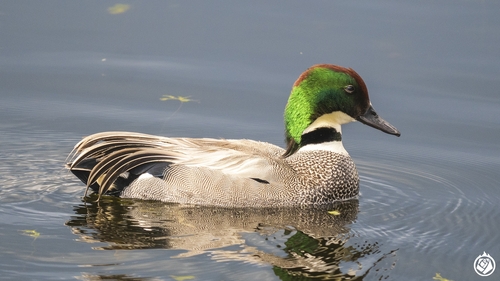
Mareca falcata, commonly known as the falcated duck, shows little size difference in length between males and females, which ranges from 46 to 53 cm (18–21 in). Their body weight spans 422 to 770 g (14.9–27.2 oz), with males consistently heavier than females. Their wingspans measure between 79 and 91 cm (31–36 in). Breeding males have a distinct, unmistakeable appearance: most of their body plumage is finely vermiculated grey, with the long sickle-shaped tertials that give the species its common name hanging off the back. They have a large dark green head, white throat, dark green collar, and bronzed crown. The vent region is patterned in yellow, black, and white. Female falcated ducks are dark brown, with plumage very similar to that of female wigeons. Their long grey bill is a helpful identifying feature. Eclipse males resemble females, but are darker on the back and head. When in flight, both sexes have a pale grey underwing. The blackish speculum is bordered by a white bar along its inner edge. Young birds are buffer-toned than adult females, with short tertials, and juvenile plumage matches that of adult females. These ducks are typically quiet except when they are on breeding territory. Males produce a shrill whistle transcribed as tyu-tyu-vit…tyu-vit…tyu-tyu-vit, and also a quiet whistle that ends with a wavering uit-trr. Females make a hoarse, quacking, short two-syllable inciting call, as well as a high-pitched, two to four syllable decrescendo call. The falcated duck breeds in eastern Asia. Its breeding range includes eastern Russia (Khabarovsk, Primorskiy, Amur, Chita, Buryatia, Irkutsk, Tuva, eastern Krasnoyarsk, south central Sakha, Sakhalin), extreme northeastern North Korea, northern China (northeastern Inner Mongolia, northern Heilongjiang), and northern Japan (Hokkaidō, Aomori, the Kuril Islands). Individuals are widely recorded far outside this normal breeding range, but the popularity of this attractive duck in captivity makes it impossible to confirm whether these extralimital birds are wild escapees or naturally wandering. This is a strongly migratory dabbling duck that winters across much of Southeast Asia. Its winter range includes India (Uttar Pradesh, Bihār, Assam, eastern Haryāna), northern Bangladesh, northern and central Myanmar, northern Laos extending to the Mekong River, northern Vietnam (from approximately Hanoi northward), and China (Hainan, Taiwan, Yunnan, Guangxi, Guangdong, Fujian, Jiangxi, northern Hunan, Hubei, Zhejiang, Anhui, Jiangsu, Shandong, southern Hebei, Shanxi, northern Shaanxi). Outside of the breeding season, the species is gregarious and forms large flocks. The total global population of falcated ducks is currently estimated at around 89,000 individuals, which is much higher than the previous global estimate of 35,000. A winter survey of a migratory stopover area in Central China recorded very low numbers: only 4 individuals were seen in 2004, and only 10 in 2005. This species inhabits lowland wetlands such as water meadows and lakes, and usually feeds by dabbling for plant food or grazing. According to 2009 IUCN data, National Nature Reserves in eastern China hold high proportions of the region’s populations of globally threatened Anatidae species, including 30% of the near threatened falcated duck population. Around 27% of the total falcated duck population occurs within these National Nature Reserves. Clutches contain between 6 and 10 eggs, which are generally laid in late May. Nests are built on the ground in thick grasses, tussocks, waterlogged shrubbery, or hidden in deadwood. Nests are usually located near water, but have also been found in small bushes around 80 m (260 ft) from water. The eggs are white with a pinkish yellow tint. Females incubate the eggs alone, with an incubation period of 24–25 days in captive individuals. Males leave the female while she is incubating. Falcated ducks have a very intricate courtship ritual. Females perform a sequence of inciting calls and other movements while preening behind the wings of their chosen male. Males use a courtship display similar to other members of the Anas genus, including an introductory shake, a neck-stretching burp call, a grunt whistle, and a head-up-tail-up display. During the mating season, falcated ducks form monogamous pairs that last for the full mating season. There is currently no published data on the typical lifespan of the falcated duck. Information on territory size is also lacking, as the species has not been studied as extensively as more well-known waterfowl such as swans or geese.