About Mantella laevigata Methuen & Hewitt, 1913
Mantella laevigata, commonly called the climbing mantella, is a small frog species.
Adult Size
Adult climbing mantellas measure 24–30 millimetres (0.94–1.18 in) in length and weigh 1.2–2.0 grams (0.042–0.071 oz).
Coloration
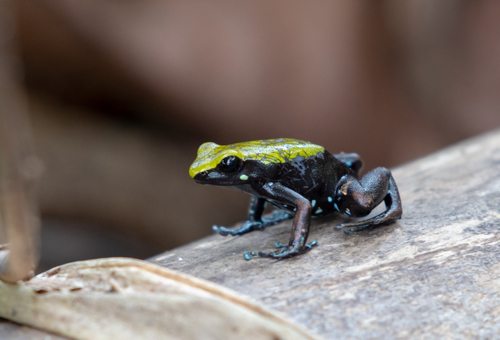
Like other poison frogs, it has bright coloration: the anterior section of its back is bright yellow or pale green, while its arms, legs, abdomen, and posterior back are black, with blue spots present on the limbs.
Eye and Limb Features
Its eyes are entirely black. The climbing mantella has webbed fingers and toes, with adhesive discs at the tip of each digit.
Sexual Dimorphism
Males are slightly smaller than females, but sex cannot easily be identified from external physical traits; males are most reliably recognized by their mating calls.
Similar Species
Three similar species are M. betsileo, M. viridis, and M. expectata. These species differ in color pattern from the climbing mantella: they typically have blue spots on the throat rather than the limbs, and all have a faint line along the upper lip, a feature the climbing mantella lacks.
Native Range and Habitat
The climbing mantella is native to the northeast coastal region of Madagascar, where it inhabits lowland rainforests and bamboo groves.
Protected Areas
It occurs in several protected areas across Madagascar, including Mananara-Nord National Park, Marojejy National Park, Masoala National Park, Nosy Mangabe Special Reserve, and Betampona Natural Reserve.
Preferred Humidity
This species prefers a humidity level between 80% and 100%.
Temperature Tolerance
It can tolerate a fairly wide temperature range of 17–30 °C (63–86 °F) compared to many other amphibian species, with the most suitable temperature range for the species being 20–26 °C (68–79 °F).