About Maniola jurtina (Linnaeus, 1758)
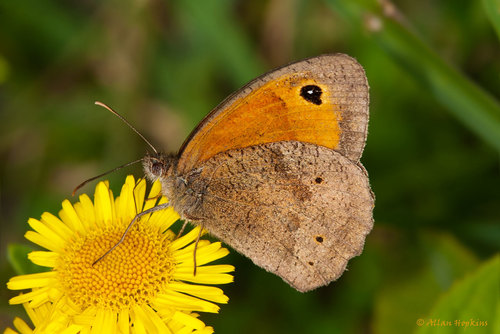
This species, Maniola jurtina, shows strong sexual dimorphism. The upperside of the male is uniformly light brown, with a black ocellus centered with white at the forewing apex; the female has a more or less extended tawny patch around this ocellus. On the underside, the male forewing is ochre-colored with a dark beige border, and retains the same apical ocellus; the female hindwing is greyish to brown with a more or less orange band. Males are also much more active and move over larger areas, while females fly less often and often do not move away from their natal area.
As described by Seitz, the upper side is dark brown, with the apical ocellus finely centered with white. In males, this ocellus is bordered with dull dark yellow; in females, it sits within an ochre-yellow half band that narrows toward the back and does not reach the hindmargin. Live males often have a striking metallic gloss on the upperside, and bear a broad scent-patch below the cell. On the underside of the hindwing, males are dark brown with a barely visible middle band, while females are grey-brown with a broad, pale curved band that has a golden-brown border on its proximal side.
The species occurs across Europe in multiple forms. Besides variants defined by the loss of ocelli or the presence of extra ocelli, there are albino forms where the blackish ground color is replaced by dirty white, while the reddish-yellow half band remains unchanged. In other variants, the reddish-yellow half band on the female forewing is pale, fading to ivory-white. Specimens have been recorded where the male's band is very prominent against a silky dust-grey upperside. The aberration cinerea has a bluish gloss on the dark upperside; its hindwing is strongly dentate, pink-tinged on the underside, and bears two eye-dots. In hot summers, it is common to find specimens with increased reddish-yellow coloration: males have yellowish-red dusting on the apical area, while females have a yellowish-red area on the hindwing disc.
Two recognized subspecies are described. Subspecies hispulla Hbn. (47b), found in Southern Europe, has all the characteristics of the nominal form more strongly pronounced, and is generally broader-winged than nominotypical M. jurtina. Subspecies fortunata Alph. (47 c) is an even paler form. Live males of this subspecies have a striking golden gloss on the apical area against a deep black ground; in females, the upper side ground color is reduced by the expansion of the reddish-yellow markings. This subspecies is also much larger, and the basal area of the hindwing underside is so darkened that the light discal band stands out in sharp contrast.
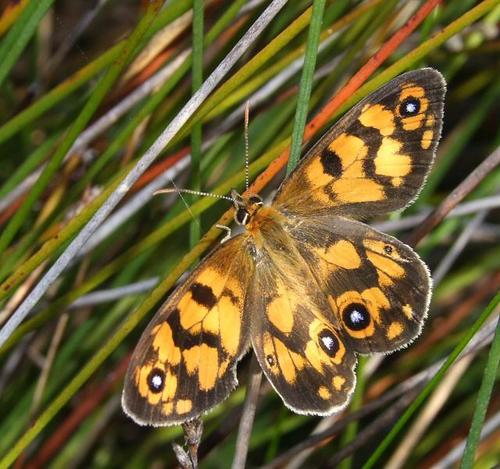
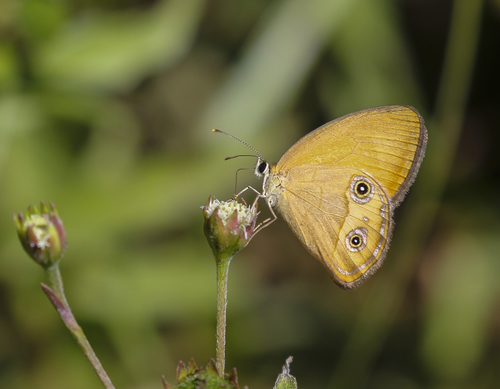
A variable number of smaller eyespots are typically present on the hindwing undersides. They can number up to twelve per individual butterfly, with up to six per wing, but sometimes no eyespots are present. The factors that control polymorphism for this trait have not been resolved, though multiple theories have been proposed (Stevens 2005). The evolutionary role of upperwing eyespots is better understood: more active males have a distinctly more cryptic upperside pattern, while females have more opportunity to use a sudden display of their eyespots, colors and patterns that is thought to startle predators, giving the butterfly a better chance of escaping. Some specimens are bi-pupilled.
The egg, larva and pupa are described as follows (South, 1906). Eggs are laid on grass blades, are upright and ribbed, with a flattened top that has an impressed ring. They are whitish-green when first laid, turning brownish yellow as they mature, and marked with purplish brown. Caterpillars are bright green, covered with short whitish hairs; they have a darker line running down the back, and a diffused white stripe on each side above the reddish spiracles; the anal points are white. The head is darker green and hairy. The chrysalis is pale green, with brownish markings on the wing covers; the thorax is spotted with blackish, and the points on the body are brownish. It is suspended, with the old larval skin still attached.
Due to its very large range, habitat is difficult to define broadly, but it most often occurs at forest edges, in forest-steppe and meadow steppe habitats up to 2,000 m above sea level, and also in cultivated areas including meadows, forest plantations, parks and orchards.
Recorded larval food plants include rough meadow grass (Poa trivialis), smooth meadow grass (Poa pratensis), species in the genus Festuca, bents (Agrostis species), cock's-foot (Dactylis glomerata), false brome (Brachypodium sylvaticum), and downy oat-grass (Helictotrichon pubescens). Less specific records also note larvae feeding on plants in the genera Poa, Bromus, Festuca, Milium, Brachypodium, Lolium, Avena, Alopecurus and Anthoxanthum. Adult butterflies feed on nectar from a wide range of plants including Centaurea, Cirsium, Leontodon, Erica, Rubus, Heracleum, Eupatorium, Origanum (sensu lato), Senecio, Scabiosa, Succisa, Ligustrum and Filipendula.