About Manihot esculenta Crantz
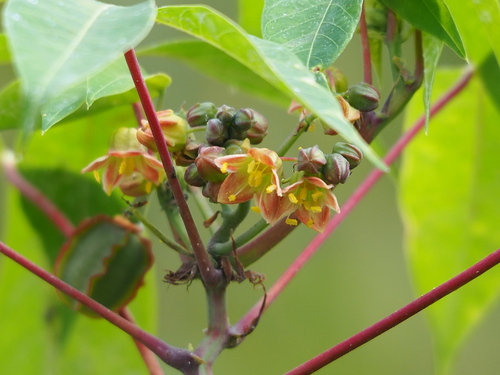
Manihot esculenta Crantz, commonly known as cassava, is a perennial plant usually harvested within one year after planting. The harvested part of cassava is its storage root, which is long and tapered, with a rough brown rind that detaches easily. The root's flesh is firm, even in texture, and can be white or yellowish. Commercial cassava cultivars typically measure 5 to 10 centimetres (2 to 4 inches) wide at the top, 15 to 30 centimetres (6 to 12 inches) long, and have a woody vascular bundle running down their center. Tuberous cassava roots are composed mostly of starch, and contain small amounts of calcium (16 milligrams per 100 grams), phosphorus (27 mg per 100 g), and vitamin C (20.6 mg per 100 g). Conventional breeding has increased total pro-vitamin A carotenoid content in cassava from a maximum of 10.3 μg/g to 24.3 μg/g on a fresh weight basis. Cassava roots contain very little protein, while cassava leaves are rich in protein, though they are low in the essential amino acid methionine. Cassava is a monoecious species, meaning it produces separate male and female flowers on the same individual plant. The flowers are arranged in inflorescences that develop at the apex of the growing stem. Buds can sprout to form new branches below the inflorescence, which allows the plant to continue vegetative growth. Farmers generally prefer non-branching, erect cassava plants because they are easier to harvest, transport, and store. However, the erect growth form complicates plant breeding, as these plants produce few or no flowers. To encourage flowering, breeders use photoperiod extension, pruning, and plant growth regulators. Cassava roots, peels, and leaves are unsafe to eat raw because they contain two toxic cyanogenic glycosides: linamarin and lotaustralin. These compounds are broken down by the cassava enzyme linamarase, which releases poisonous hydrogen cyanide. Cassava varieties are commonly classified as either bitter (high in cyanogenic glycosides) or sweet (low in these compounds). Sweet cultivars can contain as little as 20 milligrams of cyanide per kilogram of fresh roots, while bitter cultivars may contain up to 1000 milligrams per kilogram. Cassava grown during drought has especially high levels of these toxins. A 25 mg dose of pure cassava cyanogenic glucoside, which contains 2.5 mg of cyanide, is enough to kill a rat. Excess cyanide residue left by improper cassava preparation causes goiters and acute cyanide poisoning, and is linked to konzo, a neurological ataxia disorder that impairs walking ability. It has also been linked to tropical fibrocalcific pancreatitis in humans, which progresses to chronic pancreatitis. Symptoms of acute cyanide intoxication appear four or more hours after eating raw or poorly processed cassava, and include vertigo, vomiting, goiter, ataxia, partial paralysis, collapse, and death. Acute poisoning can be treated easily with an injection of thiosulfate, which provides sulfur that lets the patient's body detoxify by converting poisonous cyanide into thiocyanate. Chronic, low-level cyanide exposure can contribute to both goiter and tropical ataxic neuropathy, also called konzo, which can be fatal. The risk of severe illness is highest during famines, when up to 3 percent of the population may be affected. Like many other root and tuber crops, both bitter and sweet cassava varieties contain antinutritional factors and toxins, with bitter varieties holding much larger amounts. More toxic cassava varieties have been used as famine food during periods of food insecurity in some regions. For example, during food shortages in Venezuela in the late 2010s, dozens of deaths were reported after people ate bitter cassava to avoid starvation. Cases of cassava poisoning were also documented during the famine that accompanied the Great Leap Forward (1958–1962) in China. Farmers may choose to grow bitter cultivars to reduce crop losses. Communities that traditionally consume cassava generally know that processing methods such as soaking, cooking, and fermentation are required to avoid illness. A brief four-hour soak of cassava is not enough to remove toxins, but soaking for 18 to 24 hours can remove up to half of the cyanide content. Drying alone may also not be sufficient to remove toxins. In many West African regions, especially Nigeria, bitter cassava roots are traditionally detoxified through a lengthy process. The roots are peeled and grated, then the moist pulp is soaked (retted) in water for 48 to 72 hours to start spontaneous fermentation. During this period, endogenous cassava linamarase acts on linamarin and lotaustralin; the resulting hydrogen cyanide dissolves in water or volatilizes, reducing cyanogenic potential by 85 to 99 percent. After soaking, the mash is pressed to expel liquid, then boiled, roasted, or toasted to make foods such as gari, fufu, and lafun. This further lowers residual cyanide to within the World Health Organization's safe limit of 10 mg HCN per kilogram. For smaller-rooted sweet varieties, cooking alone is sufficient to eliminate all toxicity. Cyanide is removed in processing water, and the amounts produced for domestic consumption are too small to cause environmental harm. Larger-rooted bitter varieties grown for flour or starch production must always be processed to remove cyanogenic glucosides. The large roots are peeled and ground into flour, which is then soaked in water, squeezed dry multiple times, and toasted. Starch grains that separate out with water during soaking are also used in cooking. Cassava flour is used throughout South America and the Caribbean. Even small-scale cottage-level industrial production of cassava flour can generate enough cyanide and cyanogenic glycosides in production effluents to cause severe environmental damage. Optimal conditions for cassava cultivation include a mean annual temperature between 20 and 29 °C (68 and 84 °F), annual precipitation between 1,000 and 2,500 mm (39 and 98 in), and an annual growth period of no less than 240 days. Cassava grows best at temperatures between 25 and 29 °C (77 and 84 °F), but it can tolerate temperatures as low as 12 °C (54 °F) and as high as 40 °C (104 °F). Cassava is propagated by cutting stems into sections approximately 15 cm (5.9 in) long, which are planted before the wet season. Suitable growing conditions for cassava occur, for example, in the northern part of Mexico's Gulf Coastal Plain. In this region of Mexico, phaeozem, regosol, arenosol, andosol, and luvisol soil types have been shown to be good for cassava cultivation. There are many ways to cook cassava, and it must be prepared correctly to remove toxicity. The root of sweet cassava varieties has a mild flavor similar to potatoes. In Brazil, farofa, a dry meal made from cooked powdered cassava, is roasted in butter and eaten as a side dish or sprinkled on other foods. Jewish households sometimes use cassava farofa in cholent. Cassava can be processed into a flour that is used for breads, cakes, and cookies. In a tradition originating in Taiwanese culture and later spread to the United States, cassava-derived liquid is dried to a fine powder and used to make tapioca, a popular starch that produces tapioca pearls, the chewy topping used in bubble tea. Alcoholic beverages made from cassava include cauim (Brazil), kasiri (Venezuela, Guyana, Suriname), parakari or kari (Venezuela, Guyana, Surinam), and nihamanchi (South America).