About Manicaria saccifera Gaertn.
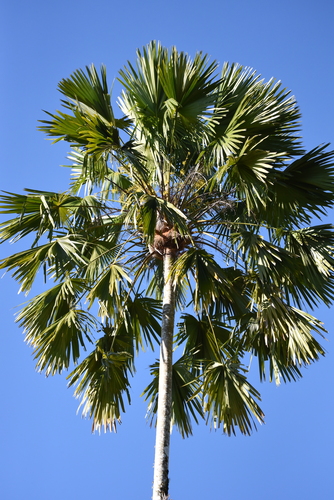
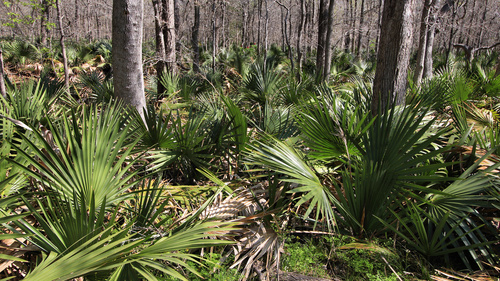
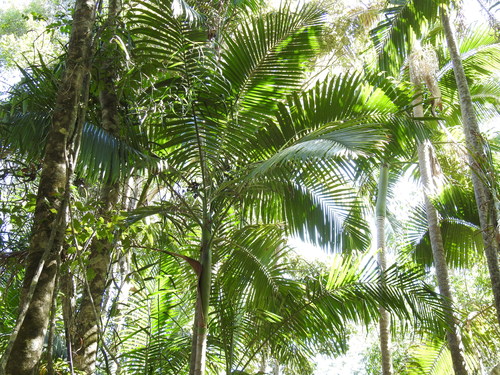
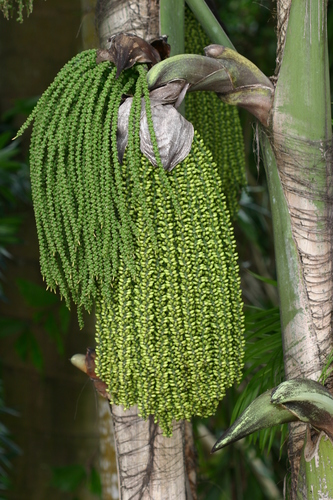
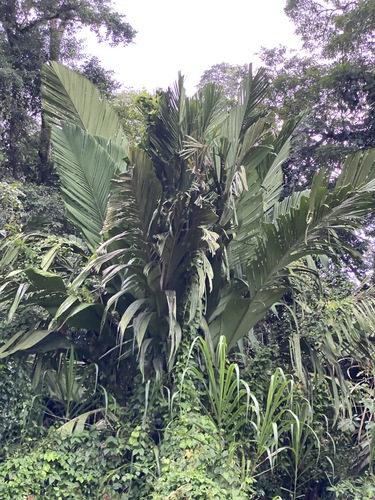
Manicaria saccifera Gaertn. is easily identifiable by its enormous, broad leaves and clusters of spiked fruit pods visible at the base of its fronds. Its leaves grow in a pinnate shape, resembling large feathers with irregular separation and serrated edges. These leaves are stiff and tough, and can cause a sharp paper cut if a hand brushes against them. The tree produces large fruit clusters year-round; each fruit forms in a shell that holds two or three seeds. The pods fall from the tree and accumulate in mounds at the tree’s base. Over time, the spiked outer pod shell breaks away, revealing the smooth round seed underneath. Some mammals, such as peccaries, eat the white flesh inside fallen seeds that have emerged from the tough outer shell, but human consumption of this fruit is not common (Myers, 1981). Because Manicaria seeds can float for extended periods, water is the main method of seed distribution for this species. Seed dispersal by animals is not effective; Myers (1981) found that seeds partially consumed or damaged by animals are unlikely to germinate. Where mammal activity is high, seed and seedling predation are also high, so Manicaria saccifera tends to thrive only in swampy regions that are less frequented by mammals. According to Myers (1981), Manicaria saccifera is an obligate swamp species that grows in freshwater swamps frequently flooded by rain or ocean tides. It can often be found in estuarine areas where a river feeds into the ocean, so the rivers or canals along which Manicaria saccifera occurs often contain brackish water. This palm typically dominates the middle vegetation strata with its broad leaves, and is often found growing mixed with Raphia palm in depressions, along waterway borders, and in mixed dicotyledonous swamp forests (Myers, 1981). The Tortuguero region on the northeast coast of Costa Rica is one important conservation area where Manicaria saccifera continues to thrive. According to the Canadian Organization for Tropical Education and Rainforest Conservation (COTERC) (n.d.), the Tortuguero region is an ancient flood plain with annual rainfall exceeding 6,000 mm and an average daily temperature of 26 degrees Celsius. Myers (1981) notes this area is aseasonal, and it is considered among the most biologically diverse regions in Costa Rica (Koens, Dieperink and Miranda, 2009; World Headquarters, 2007). Much of the Tortuguero region is covered by two protected areas: the Barra del Colorado Wildlife Refuge and Tortuguero National Park, both part of the Área de Conservación Tortuguero (ACTO). The construction of banana plantations in Costa Rica has negatively impacted both ecological and social systems. Banana cultivation requires large amounts of land, heavy application of fertilizers and pesticides, and extensive systems of shallow canals and drainage ditches (Astorga, 1998). This landscape alteration inevitably leads to deforestation and the loss of tropical flora and fauna biodiversity. To develop a banana plantation, marshes are drained, streams are channelized, and drainage canals are constructed to prevent field flooding (McCracken 1998). Historically, the banana agricultural industry has been a threat to Manicaria saccifera populations in Costa Rica. Manicaria saccifera grows and thrives in swampland, so if these areas continue to be drained for agricultural use, this palm species, along with many others, will quickly disappear. To better understand the current state of Manicaria saccifera populations and local human use of the species, an applied anthropological study of this palm was conducted at the southernmost tip of Costa Rica’s Barra del Colorado Wildlife Refuge by a Laurentian University Anthropology field course, in partnership with Caño Palma Biological Station. The station is located along Caño Palma (Palm Canal) in Tortuguero National Park, which lies within the Barra del Colorado Wildlife Refuge. Caño Palma is a palm-filled blackwater canal with hydromorphic soils that developed due to poor drainage (Myers, 1981) and has an average annual rainfall greater than 6,000 mm. This habitat is prime for Manicaria saccifera growth and survival. The study considered both biological and sociocultural aspects of this ecologically prominent palm species from an applied anthropological approach. It found that Manicaria palm density is highest in wet, swampy habitat, with lower density at all life stages in drier substrate. This confirms the palm thrives in a very specific habitat, so destruction of that habitat via commercial agricultural wetland drainage can negatively impact its populations. Many different palm species have been useful to humans across history and in modern times. All types of palms can be used for thatch for houses, wood to support dwellings, ropes, strings, weavings, hunting bows, fishing line, hooks, utensils, musical instruments, and various kinds of food and drink (Kricher, 1997:28). In Costa Rica’s Tortuguero region, “Palma Real” is mainly valued for roof thatch. Historically, according to Lefevre (1992), the Tortuguero region was dominated by the Suerre people before the 16th century. Linguistic analysis suggests the Suerre are related to the Talamancan tribes of southern Costa Rica. The Suerre used Manicaria saccifera to thatch cone-shaped ranchos, and slept on floors made of palm. In 1502, Columbus encountered 50-80,000 people living in the area. The Miskito people from Nicaragua immigrated to the area and primarily used palm thatch for their homes. Tortuguero village became a well-used shipping port for coconuts and bananas produced by local plantations. Between 1930 and 1940, Walter Martinez, along with his children and two or three other families, settled in the Tortuguero area and built four pole-supported ranchos using palm (Lefevre, 1992). Around 1995-1996, most houses in Tortuguero still had palm thatch roofs. Manicaria saccifera was the preferred palm for thatching because its wider leaves cover more area. Around this same time, the Costa Rican government introduced a permit system to limit harvesting of many natural resources, including Manicaria saccifera. As of 2010, very few buildings have thatched roofs, aside from the ranchos that many tourist lodges provide for their guests.