About Mandevilla sanderi (Hemsl.) Woodson
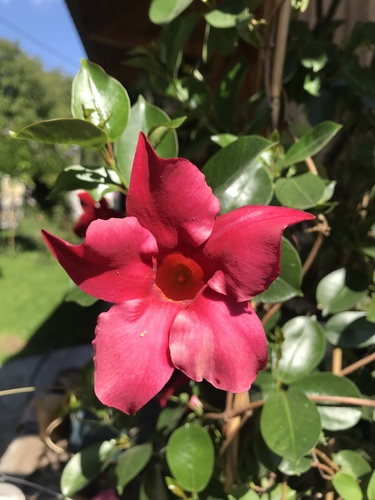
Mandevilla sanderi is a naturally bushy shrub that reaches 2–3 meters in height, growing up to 4.5 meters (15 feet) in warm climates. It produces long, woody lignin-based stems and climbs by twining around supporting structures. This twining growth has long internodes, small leaves, and stems that rarely bear flowers. The plant contains viscous, toxic, irritating white latex. Along with fine roots, it has large tuberous roots that store starch and water as a reserve, allowing the plant to tolerate drought. Its evergreen leaves are opposite, petiolate, thick, leathery, dark green, and grow up to 6 cm (2.5 in) long. The leaf blade is ovate-elliptical, 5–6 cm long, with a glossy upper surface, thick epidermis, and a shortly acuminate apex. Inflorescences are simple racemes, usually terminal and sometimes axillary, that hold 3–5 buds and one large open pink-red flower 4–7 cm in diameter at one time. Each flower has a cup-shaped calyx with five lanceolate-subulate scarious teeth. It has a large funnel-shaped (infundibular) pink corolla made up of a cylindrical tube 4–5 mm in diameter, which widens abruptly into a wider section 15–18 × 25–30 mm, ending in five acuminate, spreading, partially overlapping oval lobes. The five stamens have filaments inserted into the corolla tube, with connective anthers that form a ring around the stigma. The main long flowering period runs from spring to autumn; flowers also develop gradually from early summer to late winter, growing 2–3 per stalk in leaf axils. The fruit is a dry capsule formed of two long follicles, which opens lengthwise like a silique.