About Mammillaria spinosissima Lem.
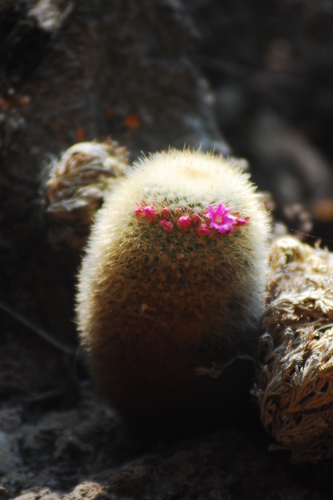
Mammillaria spinosissima Lem., commonly called the spiny pincushion cactus, is a cylindrical cactus species that grows up to 30 cm (12 in) tall and 10 cm (3.9 in) wide, reaching its full height between five and ten years. It can also produce relatively small globular or elongated stems. The stem is woolly, covered in bristles, and bears spines that are red-brown or white, with cream-colored radial spines. Pink, funnel-shaped flowers grow in a ring around the stem apex, reaching roughly 2 cm (0.79 in) in length. After flowering, these cacti produce generally bright red, club-shaped, smooth, juicy berries. Like other species in the Mammillaria genus, this cactus typically grows low to the ground, either as a solitary plant or in clustered groups. The Mammillaria genus is defined by its dimorphic areoles: spine-producing vegetative areoles sit on the apex of the tubercle, while flowering areoles are located inside the tubercle axils. The broader Mammillaria genus has a native range extending from Colombia and Venezuela to the Southwestern United States, with the greatest species diversity found in Mexico, and some species also documented in the West Indies. M. spinosissima is endemic to central Mexico, concentrated in the states of Guerrero and Morelos. It grows at elevations between approximately 1,600 and 1,900 meters (5,200 to 6,200 ft), where it prefers dry tropical forests and xerophilous scrub. One subspecies, M. spinosissima subsp. pilcayensis, is named for its native location in Barranca de Pilcaya, Guerrero. According to Britton and Rose, M. spinosissima has been grown in cultivation since at least 1835. This species grows best in well-drained sandy or loam soils, and tolerates acidic, alkaline, or neutral pH levels. It prefers low humidity, and grows well under glass with full filtered sun from southern, northern, or eastern exposures. In cultivation, plants are typically watered once every two to three weeks, and kept almost completely dry during the winter months. It can be propagated by offsets, or by seeds sown in early spring when temperatures are between 19 and 24 °C (66 to 75 °F). It requires no pruning, makes an excellent patio or container plant, and is generally disease resistant, but is susceptible to infestation by mealybug pests. This plant has been awarded the Royal Horticultural Society's Award of Garden Merit.