About Malva verticillata L.
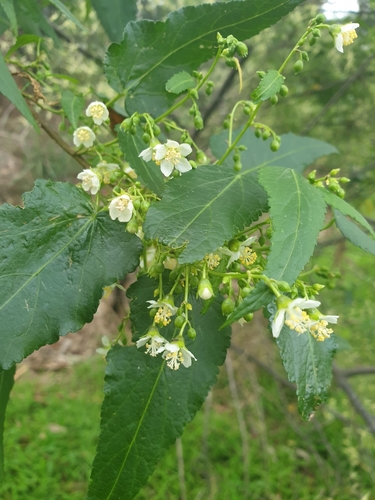
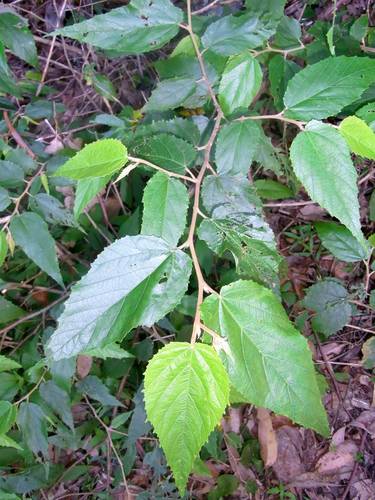
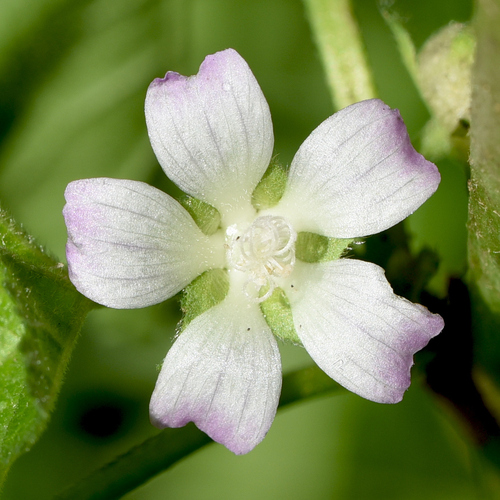
Malva verticillata, commonly called Chinese mallow or cluster mallow, is a species in the mallow genus Malva, family Malvaceae. It is native to East Asia, ranging from Pakistan to China. This is an annual or biennial plant that grows up to 1.7 meters tall, and can grow in woodland areas across different soil types. Its small, symmetrical flowers have five 0.8 cm long petals that can be white, pink, or red, with thirteen or more stamens. Each flower also has three narrow epicalyx bracts. Its fruit is a dry, hairless nutlet, and its leaves are simple and arranged alternately. In temperate climates, it flowers from July to September, and produces seeds from August to October. Its flowers are self-fertile, and can also be pollinated by insects. The species originates from Asia. It is now widely distributed across Europe, where it is considered an invasive plant. It is also found in North America, including most states in the USA. This plant was an important widely cultivated leaf vegetable in pre-Han China. It is listed in Huangdi Neijing as one of the five edible herbs (五菜), alongside pea leaves, Allium macrostemon, Welsh onion, and garlic chives. During Duke Cheng's reign recorded in the Zuo Zhuan, Confucius compared the head of the Bao clan to kuicai (this mallow), saying the clan head was not as wise as the mallow, which keeps its roots grounded. It is said to have been a major vegetable until the Northern Wei dynasty. Domestication techniques for this mallow were well documented in Qimin Yaoshu. Cultivated acreage for the species declined after the Tang dynasty. In his Nong Shu (Agricultural Manual), Wang Zhen wrote that mallow ranked first among various vegetables, because "it could be used as an alternative food in years of crop failure, or be marinated to serve alongside staple foods". Cultivation and consumption of mallow became very rare by the Ming dynasty. It is also grown as an ornamental plant.