About Malva parviflora L.
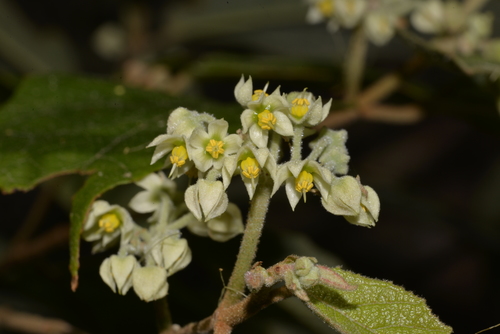
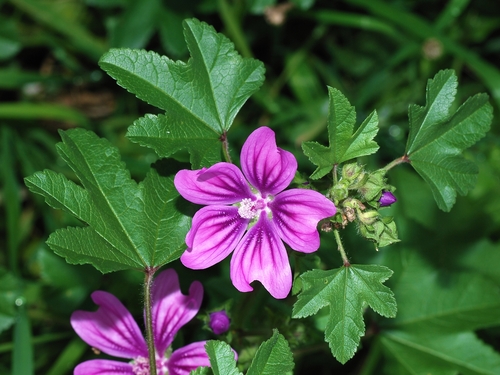
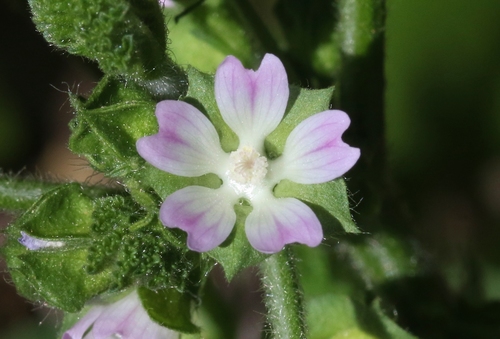
Malva parviflora L. (M. parviflora) has a decumbent or erect growth habit, reaching 50 to 80 cm in height. Its broad leaves measure 8 to 10 cm in diameter and have 5 to 7 shallow lobes. The edges of the lobes are round-toothed, and leaf hairiness varies across plants. It produces small white or pink flowers at the base of leaf stalks year-round; each flower’s petals are 4 to 10 mm long. Its seeds are 2 mm across, reddish-brown, and kidney-shaped. Newly sprouted M. parviflora plants have hairless, heart-shaped cotyledons on long stalks, which measure 3 to 12 mm long and 3 to 8 mm wide. Plant stalks are usually hairy. The first true leaf is rounder and larger than subsequent true leaves. Mature true leaves are round, weakly lobed, have wavy, shallow-toothed edges, and a distinct red spot at the leaf base. The species rapidly develops a deep taproot, and has a diploid chromosome count of 42. M. parviflora typically grows on agricultural lands and in disturbed sites such as roadsides. Its native range stretches from the Mediterranean, through West Asia, to Central Asia, and it is native to Algeria, Egypt, Libya, Morocco, Tunisia, Kuwait, Afghanistan, Cyprus, Iran, Palestine, Jordan, Lebanon, Syria, Turkey, Armenia, Azerbaijan, Turkmenistan, Albania, Bosnia and Herzegovina, Greece, Croatia, Italy, Malta, Spain, France, and Portugal. The species is widely naturalized in other regions, including North America where it has been present since the 19th century, and it is classified as a naturalized weed in Australia. M. parviflora accumulates pollutants such as cadmium and chromium. When growing in nitrogen-rich soils, the plant’s leaves and seeds can become toxic to cattle and poultry due to accumulated nitrates. If consumed in large amounts, the plant can damage energy homeostasis in horses, an effect possibly linked to its cyclopropene fatty acids. The entire M. parviflora plant is edible, and can be consumed both raw and cooked. It has a mild flavor similar to chard, and a mild, earthy aroma. The species has been used to make infusions, decoctions, and poultices as part of traditional medicine. In Mexico, it is eaten as a quelite, and used in traditional medicine to treat wounds and digestive problems. In the 20th century, naturalist Alfonso Herrera Fernández recorded that dried M. parviflora leaves were used in moisturizing poultices, and flowers were used in infusions to induce perspiration. Specifically in Zapotitlán, Puebla, roots are prepared as an infusion to treat dysentery. In Jordan, leaves are used in infusions and poultices as an emollient, laxative, carminative, and anti-hemorrhoid treatment. In Lebanon, leaves are prepared as a decoction to treat catarrhs, kidney infections, kidney stones, respiratory infections, and constipation. In Ethiopia, roots are used to treat asthma and wounds. Few clinical trials have tested the efficacy of the traditional medicinal uses of M. parviflora. Preclinical studies have found that extracts from various parts of the plant have antimicrobial and antifungal properties, but this effect is usually weaker than the effect of standard antibiotics. The plant’s roots and leaves have antioxidant and anti-inflammatory properties. Some research suggests the plant may have an anti-diabetic effect, but the strength of this effect is disputed. Extracts of M. parviflora have shown potential for treating hypertension and Alzheimer’s disease in mouse studies.