About Malva alcea L.
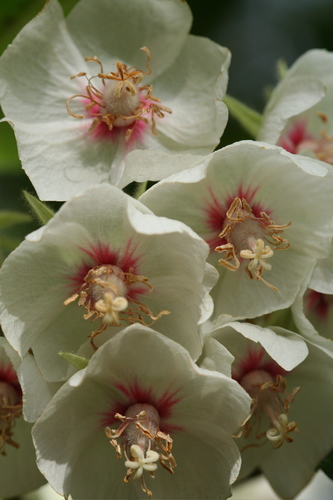
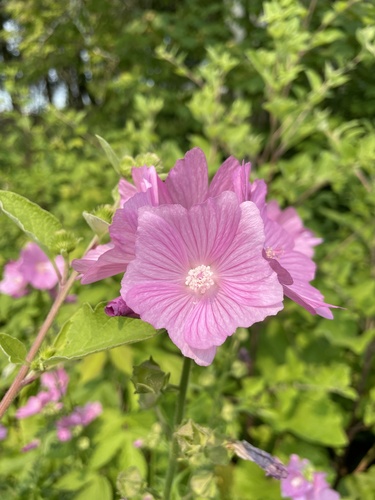
Malva alcea L. is a herbaceous perennial plant that reaches 50 to 125 centimeters in height. Its stems are covered in stellate hairs, which branch into several strands at their free end. The plant's leaves measure 2 to 8 centimeters long and 2 to 8 centimeters wide, and are palmately lobed with five to seven blunt lobes. Basal leaves on the lower part of the stem are very shallowly lobed, while leaves growing higher on the stems are deeply divided into finger-like, digitate lobes. Flowers grow singly near the apex of corymbose racemes that emerge from leaf axils, blooming from summer to early fall. The flowers are 3.5 to 6 centimeters in diameter, with five sepals, five bright pink petals, and no scent. The bracteoles forming the epicalyx are ovate, wide at their base, and fused to the calyx. The fruit is a hairless, disc-shaped schizocarp 4 to 8 millimeters in diameter, which holds multiple seeds; each individual seed is enclosed in a glabrous or hairy mericarp. This species has a chromosome count of 2n=84. Ecologically, Malva alcea L. is most common in drier soils in thickets, along paths, and in waste places. Natural hybrids with the closely related Malva moschata are occasionally found. In central Europe, it grows at altitudes up to 2,000 meters. It has been widely cultivated as an ornamental plant outside its native range, with several established cultivars: 'Fastigata', an upright growth form, and 'Alba', a white-flowered form, among others. In some regions including the northeastern United States, the plant has escaped from cultivation and become naturalized. It is very similar in appearance to Malva moschata, and the two species are often confused with one another.