About Malva acerifolia (Cav.) Alef.
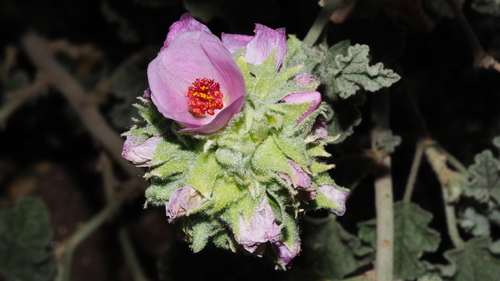
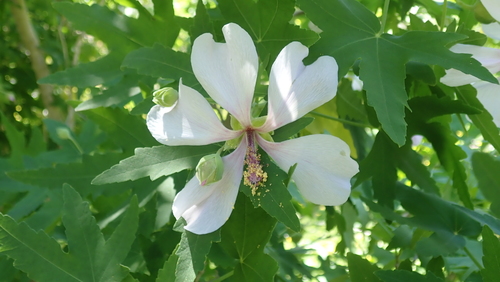
Malva acerifolia (Cav.) Alef. is a plant that grows as a small tree or shrub. When cultivated, it reaches approximately 5 feet in height within three to four years, and can grow up to three meters tall in its native habitat. It is easily identifiable in its natural location by its large flowers. Its branches grow in an alternate arrangement, and the bark of older individuals turns ashy-grey. The leaves are also alternate; they reach 4 to 5 inches long in the plant's first year, then decrease in size to 2 to 3 inches in subsequent years, and are always smaller than their leaf stalks (petioles). The leaves are palmately lobed, with 5 to 7 supple, lanceolate lobes that have smooth, toothless margins. Each lobe has a matching central vein that extends to the base of the leaf. Its stipules are awl-shaped. The flowers grow solitary in leaf axils, on slightly bent flower stalks (peduncles) that are always much longer than the leaf petioles. The calyx is hairless, and the corolla is around three inches in diameter, with five petals (one petal may occasionally be underdeveloped) that widen toward their tip. Cavanilles described the petals as light pink with dark purple streaks near the base and white undersides; they have also been described as very pale lilac, almost white, with a darker color at the base of the petals. The pistil styles and stamen filaments are grouped together in a column and are purple in color. The pollen is spherical and depressed in shape. There is one seed per locule, and the seeds are arranged in a wheel, with the number of seeds (12 to 15) matching the number of stigmas. This shrub was first collected by French biologist Pierre Marie Auguste Broussonet on the island of Tenerife, during his stay there at the turn of the 18th century. Broussonet could not finish his planned work on the island's flora, but he sent a number of seeds to his friend Cavanilles, who described the species from plants grown from these seeds in his gardens. The nominate variety grows on the islands of Gran Canaria, Tenerife, Gomera, and La Palma in the western part of the Canary Islands archipelago; the variety hariensis occurs on Fuerteventura and Lanzarote in the east. El Hierro is the only island in the archipelago where this species does not grow. This species reached the Canary Islands from a Mediterranean origin, and is more recent to the islands than other endemic species such as Lavatera phoenicea, which colonized the islands earlier and independently of Malva acerifolia. Its closest relative is not confirmed, because there is incongruence between chloroplast and nuclear molecular markers. Malva acerifolia grows at lower elevations of the Canary Islands, in dry, sunny locations. It can be found growing on cliffs and in rocky scrubland. It is a somewhat ruderal species, and prefers nitrogen-rich soils, especially on disturbed ground or abandoned farmland. It is pollinated by insects, most commonly bees. This plant makes good fodder for livestock. In some parts of the Canary Islands, these shrubs were traditionally cultivated as an ornamental in rural areas; today, it is planted in urban gardens across the islands, valued for its attractive flowers, rapid growth, and easy cultivation.