About Malus sylvestris Mill.
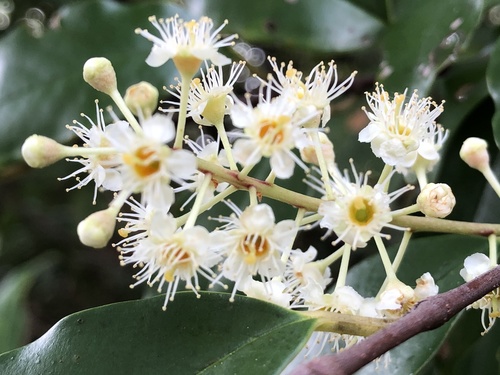
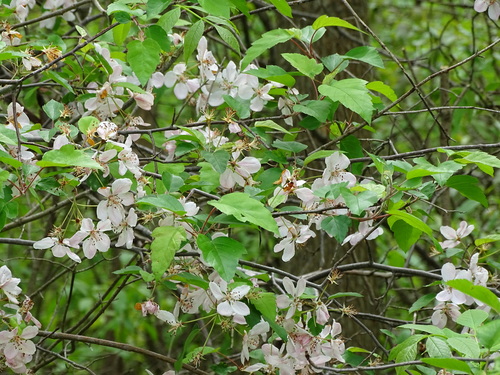
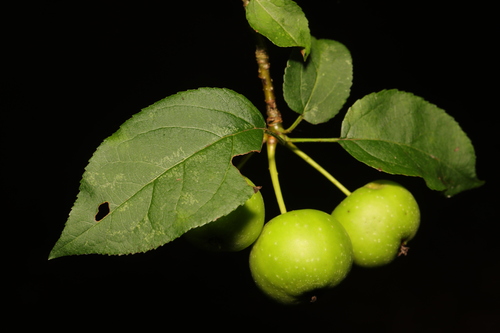
Malus sylvestris, commonly known as the European wild apple, is a deciduous species that most often grows as a small to medium-sized tree, but can also develop into a multi-stemmed bush. Wild apple individuals can live 80 to 100 years, reaching up to 14 metres (46 feet) tall, with trunk diameters typically between 23 and 45 centimetres (9 to 17.5 inches); specimens with trunk diameters over 90 cm (35 in) have been recorded. Its leaves are roundish-oval, and are sometimes hairy on the underside. It produces hermaphrodite flowers that open in May, appearing slightly earlier than hawthorn flowers. The flowers have white or pinkish petals and are pollinated by insects. Its small pome fruits grow to around 3 cm (1 1/4 in) in diameter, ripen in autumn, and then fall to the ground. The species' bark is light brown and flakes, and its branches are spiny, particularly after pruning or browsing.
European wild apples hybridize easily with domesticated apples, which often makes identification difficult, because hybrids typically show intermediate traits from both parent species. Definite confirmation of a pure wild apple requires genetic testing, but field identification can be done by checking a set of key features. Pure wild apples have a densely branched crown, while domesticated apples have a more open, loosely arranged crown with fewer, straighter branches. Wild apple leaves tend to be smaller, stiffer, and shinier than those of domesticated or hybrid apples. The underside of wild apple leaves is usually less hairy than that of domesticated or hybrid apples, and is often completely hairless. Pure wild apple fruits are also typically smaller, usually under 3 cm (1 1/4 in) in diameter, compared to the larger fruits of domesticated and hybrid apples. A 2022 study by Feulner et al. found that reliable field identification is possible, but requires access to the plant's flowers. Pure wild apples can be reliably distinguished from hybrids by a combination of traits: a hairless calyx, hairless midrib and veins on the underside of the leaf, and at most only sparse hair on the leaf surface. Of these traits, calyx hairiness was found to be the most important: hybrids consistently have hairy calyces, even when their leaves are completely hairless.
This species is widespread across most of Europe, absent only from the continent's extreme northern and extreme southern regions. It also grows in Anatolia and extends into the South Caucasus. Wild apples occur in a scattered distribution pattern, growing as single individuals or in small groups. Because the species is a weak competitor and requires high levels of light, it is most often found in locations with reduced plant competition, such as wet forest edges, wood pastures, farmland hedges, or very extreme marginal sites. In the British Isles, it grows throughout Ireland, England, and Wales, and occurs at lower frequency in Scotland, where it is most common in woodlands and wood pastures.
European wild apple seeds are primarily dispersed by mammals that eat its fruits. A study conducted in Mols, Denmark found that cattle were responsible for the majority of seed dispersal, followed by horses, even when wild animals were present in the area. In Britain, wild crab apple is associated with 93 insect species, and its leaves serve as a food source for the hawthorn moth (Scythropia crataegella). Across its entire native range, the wild apple is considered threatened and rare. Its main threats include genetic introgression from domesticated apples, lack of natural regeneration, and modern forestry practices that encourage closed forest canopies, in place of the traditional coppice management that was common historically.
Wild apple has many adaptations to grazing and the presence of large herbivores, and as a result it is highly dependent on these animals. It grows thorns, resprouts readily making it suitable for coppicing, and is a very hardy tree that can survive crown collapse and breakage of major branches. It is also strongly dependent on bovines and equines for seed dispersal. After the extinction of wild horses and aurochs, and the near-extinction of European bison, domesticated livestock took over this dispersal role, replacing the extinct wild megafauna. However, starting in the 16th century traditional open pasturage in town commons was abolished, and modern agricultural intensification has shifted livestock rearing to factory farms. As a result, these large herbivores are now largely absent from most European landscapes. Research shows that prehistoric Europe was dominated by half-open savanna ecosystems shaped and maintained by large megafauna, but these ecosystems no longer exist today. Much of modern European landscape consists of closed-canopy, often intensively managed forest, plus agricultural fields and urban areas, with little transitional habitat such as mantle and fringe vegetation. Because of this, the European wild apple now lacks both suitable habitat and sufficient seed dispersal opportunities, which leads to a lack of successful natural regeneration.