About Malus coronaria (L.) Mill.
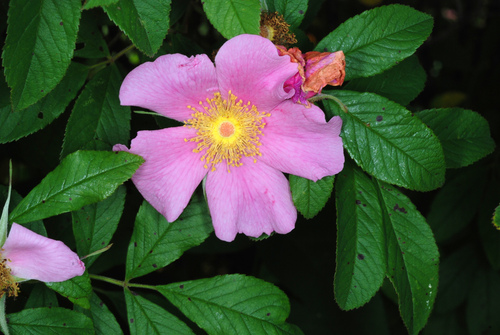
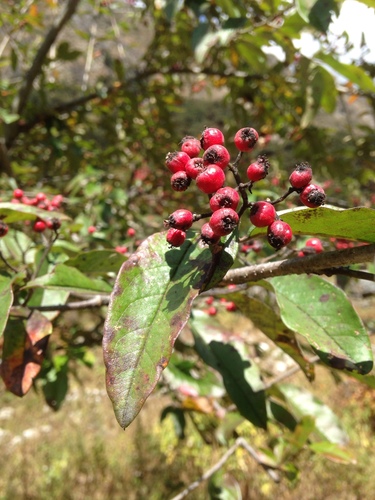
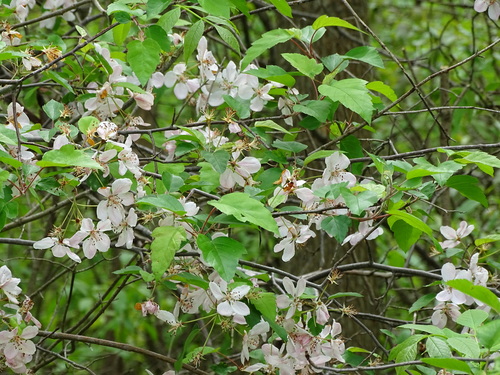
Malus coronaria (L.) Mill. most often grows as a bushy shrub with rigid, twisted branches, but it frequently grows into a small tree reaching up to 10 metres (33 feet) tall, with a broad open crown. It flowers about two weeks later than the domestic apple, and its fragrant fruit remains attached to branches on clustered stems long after the leaves have fallen. The bark is reddish brown, longitudinally fissured, and its surface separates into narrow scales. Young branchlets are first covered in thick white wool; later they become smooth and reddish brown. In their second year, branchlets develop long, spur-like branches, and sometimes develop solid thorns 2.5 centimetres (1 inch) or longer. The heartwood is reddish brown, and the sapwood is yellow. The wood is heavy, close-grained, and not strong; it is used for tool handles and small domestic articles. It has a specific gravity of 0.7048, and a density of 703.5 kilograms per cubic metre (43.92 pounds per cubic foot). Its winter buds are bright red, obtuse, and very small. The inner bud scales grow with the new developing shoot, reaching 15 millimetres (1⁄2 inch) long and staying bright red before they fall off. Its leaves are alternate, simple, and ovate, measuring 7.5–10 cm (3–4 inches) long and 4–5 cm (1+1⁄2–2 inches) broad. The base of the leaf is obtuse, subcordate, or acute, the margins are incisely serrate, leaves on vigorous shoots are often three-lobed, and the apex is acute. Leaves are feather-veined, with the midrib and primary veins grooved on the upper surface and prominent on the lower surface. When they emerge from the bud they are involute, red bronze, tomentose, and downy. When fully grown, the upper leaf surface is bright dark green, while the lower surface is paler. In autumn, leaves turn yellow. Leaf petioles are slender and long, and often have two dark glands near the middle. Stipules are filiform, 15 mm (1⁄2 inch) long, and fall off early. Flowers bloom from May to June, when leaves are nearly fully grown. The flowers are perfect, rose-colored, fragrant, and 4–5 cm (1+1⁄2–2 inches) across. They are produced in umbels of five to six flowers on slender pedicels. The calyx is urn-shaped, downy or tomentose, and five-lobed; the lobes are slender, acute, persistent, and imbricate in the bud. The corolla has five rose-colored petals, which are obovate, rounded at the upper end, have long narrow claws, have undulate or crenelate margins, are inserted on the calyx tube, and are imbricate in bud. There are 10–20 stamens, inserted on the calyx tube and shorter than the petals. The filaments form a tube narrowed in the middle and enlarged above via a partial twist. The anthers are introrse, two-celled, and open longitudinally. The pistil is made of five carpels inserted at the bottom of the calyx tube and united into an inferior ovary, with five styles and capitate stigmas; there are two ovules in each ovary cell. The fruit is a pome (apple) that ripens in October. It is depressed-globular, 2.5–4 cm (1–1+1⁄2 inches) in diameter, and crowned with calyx lobes and the remnant of filaments. It is yellow-green, very pleasantly fragrant, and its surface is sometimes waxy. The flesh is white, delicate, and contains malic acid. Each cell holds two seeds, or one seed if one aborts; seeds are chestnut brown and shiny, with fleshy cotyledons. This species grows primarily in the Great Lakes Region and the Ohio Valley, with isolated outlying populations as far from this core area as Alabama, eastern Kansas, and Long Island. It prefers rich, moist soil. The fruit is used to make preserves and cider. Pehr Kalm, a student of 18th-century botanist Carl Linnaeus, wrote the following about the fruit: The apples, or crabs, are small, sour and unfit for anything but to make vinegar of. They lie under the trees all winter and acquire a yellow color. They seldom begin to rot before spring comes on.