About Malus baccata (L.) Borkh.
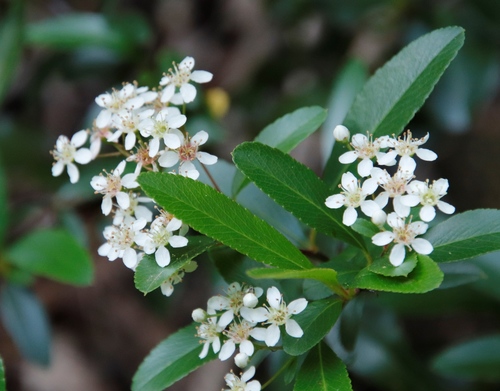
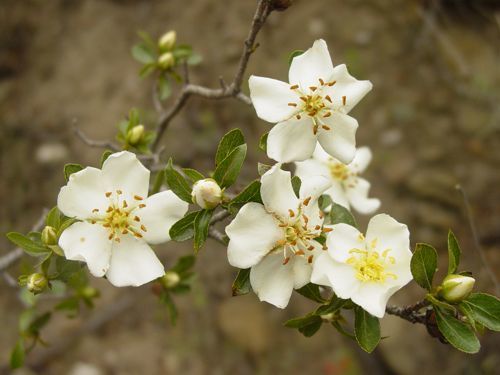
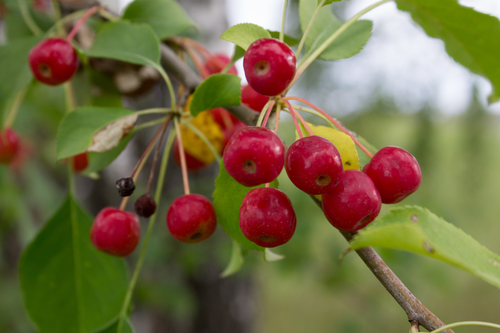
Malus baccata (L.) Borkh. is a tree that can grow to 10–14 m (33–46 ft) in height. It has arching or overhanging red-brown branches and red-brown buds. Its leaf petioles are 2–5 cm (3⁄4–2 in) long with few glands. Leaves are elliptical or egg-shaped, measuring 3 cm–8 cm × 2 cm–3.5 cm (1+1⁄4 in–3+1⁄4 in × 3⁄4 in–1+1⁄2 in). Flower pedicels are slender and 1.5–4 cm (5⁄8–1+5⁄8 in) long. Flowers grow in groups of four to six; they are white, fragrant, and 3–3.5 cm (1+1⁄8–1+3⁄8 in) in diameter. Petals are white, egg-shaped, and about 2.0–2.5 cm (3⁄4–1 in) long. Fruits are spherical, red to yellow, only about 1 cm (3⁄8 in) in diameter; they form dense clusters, and resemble cherries when viewed from a distance. This species flowers in spring, and fruits ripen in September and October. This tree is native to Russia, Mongolia, China, Korea, Bhutan, India, and Nepal. In its native range, it is common in mixed forests growing on hilly slopes at elevations up to 1,500 m (4,900 ft). It also grows in Japan, and has been introduced to Europe and North America. In North America, it grows wild mostly in the Great Lakes Region and the Northeastern United States. Malus baccata is planted as an ornamental tree valued for its flowers and fruit. Its fruits are edible and can be eaten fresh or dried. It is one of the tallest species in its genus, and is resistant to cold and pests. Because of these traits, it is used for experimental breeding and grafting of other crabapples and domesticated apples. It is a common source of genetic material for M. pumila and M. asiatica in northern and northeastern China. Its variety M. baccata var. mandshurica is used for bonsai.