About Malosma laurina (Nutt. ex Torr. & A.Gray) Engl.
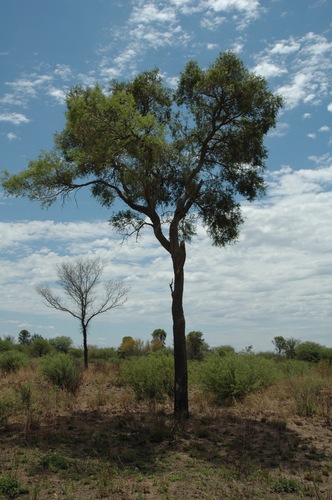
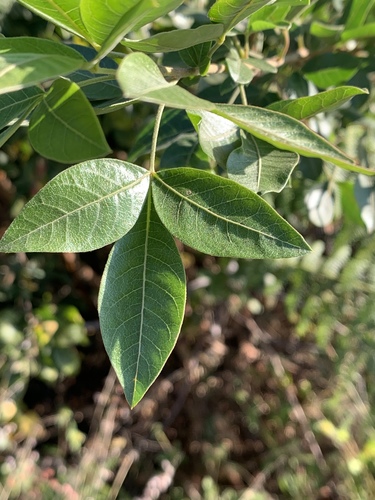
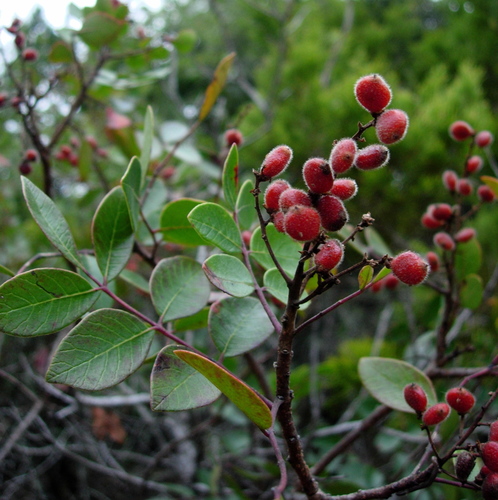
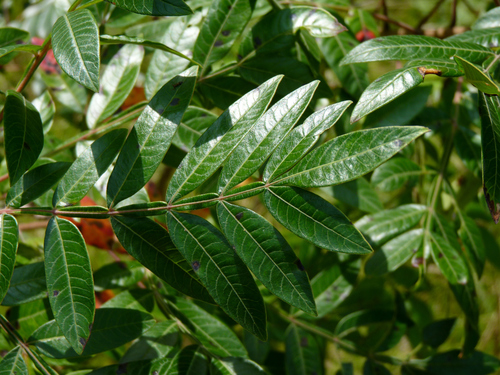
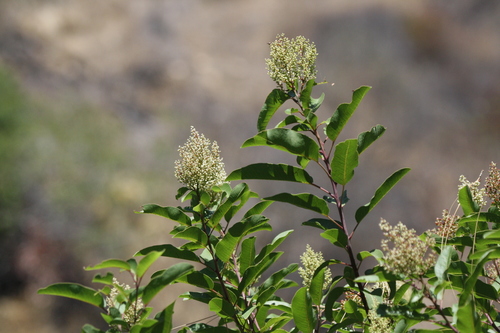
Malosma laurina, commonly called laurel sumac, is a large, rounded evergreen shrub or small tree that reaches 3 to 5 meters (9.8 to 16.4 ft) in height. Its leaves have a natural taco shell shape; when flattened, they resemble laurel leaves, with lance-shaped leaf blades growing up to 10 cm (3.9 in) long. Year-round, the stem tips, leaf petioles (the small stems that attach leaves to main stems), leaf veins, and leaf edges are a bright glowing reddish color. The species' fragrant leaves and stems contribute the characteristic scent of chaparral habitat, as their tissues are rich in volatile compounds that produce this aroma. Laurel sumac is adapted to the 50-100+ year fire return intervals of the chaparral areas where it grows; after fire burns away its above-ground parts, new stems and leaves resprout from a large underground burl. In the Mediterranean climate of its native southern California range, winters are relatively wet and summers are dry. Unlike most other local plants, which stop leaf growth during the dry summer season to direct energy to their root systems, laurel sumac produces new leaves and stems year-round, even in the dry season. Fragrant sap circulates through the plant year-round to supply its leaves. One result of this continuous growth is that laurel sumac is one of the first plants to resprout after a fire, sprouting new growth before winter rains break the dry-season dormancy of other plants. A second result is that the parasitic California dodder (Cuscuta californica), which dies off in summer on other host plants, can often be seen covering laurel sumac in large stringy yellow-orange "cobwebs". Laurel sumac is sensitive to cold and does not tolerate extended freezing conditions well. In the early history of southern California, orange growers used the presence of laurel sumac to select suitable planting sites, since its growth indicated that temperatures would not drop low enough to harm orange trees. The species produces very small flowers, each with five white petals and five-lobed green sepals. Large clusters of these flowers, called panicles, grow at the ends of twigs in late spring and early summer. The panicles measure 7–15 cm (3 to 6 inches) long and resemble lilac flower clusters. The fruit is a whitish drupe 3 mm (1⁄8 inch) in diameter, containing a smooth, somewhat flattened stone inside. When in bloom, the flowers release a "woodsy-herbal" scent that has been compared to both green apples and turpentine. Malosma laurina is distributed along the southern California coastline, primarily from Point Conception south to La Paz, and also grows on several of the Channel Islands off the coast. There are also verified records of the species growing north of Point Conception near the city of Arroyo Grande, California. It is not frost-hardy, and occurs in coastal sage scrub, chaparral, and oak woodland plant communities. It occasionally forms nearly pure stands in coastal sage scrub, but more often grows as a codominant with California sagebrush (Artemisia californica) and black, white, or purple sage (Salvia mellifera, S. apiana, or S. leucophylla). In mixed chaparral, it often codominates with bigpod ceanothus (Ceanothus megacarpus) and spiny ceanothus (C. spinosus). In oak woodlands, it is an understory associate of Engelmann oak (Quercus engelmannii), valley oak (Q. lobata), coast live oak (Q. agrifolia), and California black walnut (Juglans californica). In cultivation, Malosma laurina is commonly used as a landscape plant for native plant gardens, xeriscape gardens, and wildlife gardens in frost-free areas. Naturally growing populations have served as "sentinel plants" for avocado and citrus growers in Southern California, indicating frost-free areas suitable for commercial orchard establishment. The Chumash people crushed and ate the dried fruits of Malosma laurina, likely as a flour or meal, and also used the root bark to make a tea for treating dysentery.