About Mallotus repandus (Rottler) Müll.Arg.
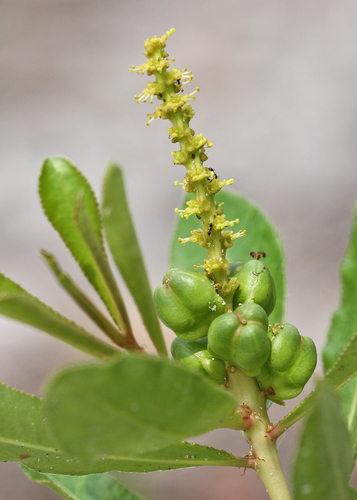
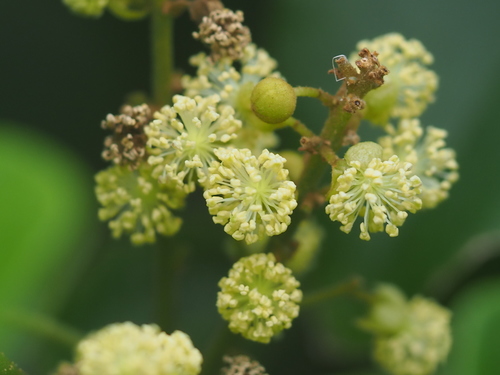
Mallotus repandus (Rottler) Müll.Arg. is an evergreen vine that can reach up to 20 m (66 ft) in length, with a maximum stem diameter of 22 cm (8.7 in). It is the only species within the Mallotus genus that grows as a liana. Its bark is dark brownish grey, while its branchlets, petioles, and inflorescences are dull yellowish-brown. A longitudinal cut of the bark (called a blaze) is finely layered, and has an odour resembling green peas (Pisum sativum). Its leaves are simple, broad, and slightly peltate. Its flowers are yellowish; in China, it flowers from March to May, and produces fruit from June to September. This species can be told apart from other Mallotus species by its climbing growth habit, the presence of more than 2 marginal extrafloral nectaries on its upper leaf surface, and its fruits which are (1-) 2- or 3-locular. A molecular phylogeny study identifies M. repandus as the sister species of M. philippensis (Lam.) Muell.Arg. The leaf hairs (indumentum) of this plant are simple and multicellular, a trait only shared with the closely related M. philippensis within the Mallotus genus. This climbing species grows as either a climber or shrub, and occurs locally scattered in the understorey of primary to secondary forest, as well as in disturbed sites and scrub. It can be found at forest edges, mangrove swamp edges, along roads and rivers, on ridges, steep slopes, and dry ground. It grows on a wide variety of soil types, including soils derived from limestone and granite, sandy loam, and rocky soils. It occurs at altitudes ranging from sea level up to 1,500 m (4,900 ft), and generally flowers and fruits throughout the year. In Queensland, it grows in both lowland and upland rain forest at elevations from near sea level to 750 m (2,460 ft). In Southeast Asia, this liana or shrub grows in secondary vegetation or on the edges of dense forests. In China, it is found in thickets, forests and their fringes, and hills and mountain valleys below 100 m (330 ft). The plant is sometimes damaged by infestations of the parasitic plant Cuscuta japonica (Japanese dodder). It provides food for the moth Acrocercops zopherandra, and is one of three Mallotus species that host the fungus Cercospora malloti. The climbing mallotus is native to a very wide range from India to Oceania, including India, East Himalaya, Nepal, Bangladesh, Sri Lanka, the Andaman and Nicobar Islands, most of east, central, and southern China, Taiwan, Myanmar, Laos, Vietnam, Thailand, Cambodia, Malaysia, Indonesia, the Philippines, New Guinea, Queensland, New Caledonia, and Vanuatu. On the island of Rote in eastern Indonesia, the wood of this plant (called bina locally) is one of two types used to make the bars for meko ai, a xylophone with wooden bars, and the plant is mentioned in an origin myth for this musical instrument. In Cambodia, the wood is used to make charcoal powder. In Kut Chum District, central northeast Thailand, it is used in folk medicine as an antibiotic; Northeastern Thai people use it to relieve bone pain, while elsewhere in Thailand the bark is used in ethnomedicine to treat herpes simplex, inflammation, and liver poisoning.