About Mallotus japonicus (L.f.) Müll.Arg.
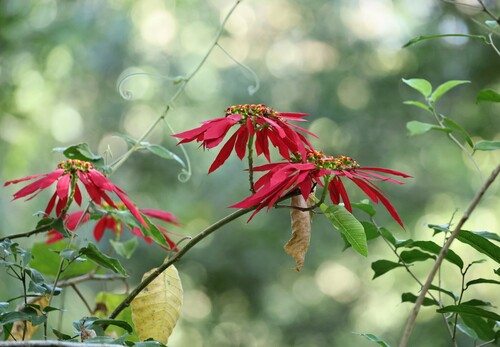
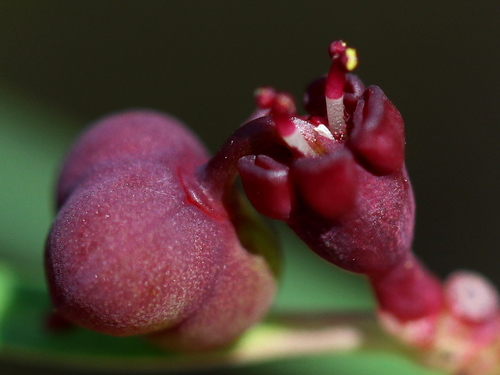
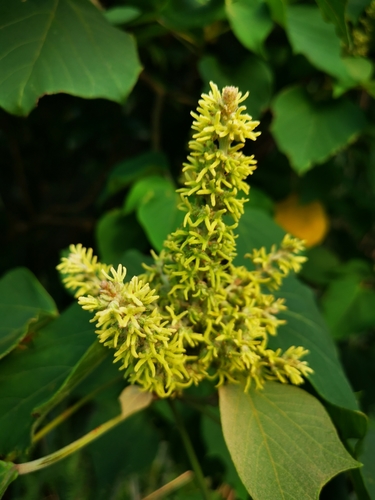
Mallotus japonicus (Chinese: 野梧桐), also called East Asian mallotus, the food wrapper plant, and "Akamegashiwa" in Japanese, is a plant species in the genus Mallotus. It is native to China, and can also be found in Japan and Korea. This species was first formally described in 1865, and its name was verified by AAS Systematic Botanists on October 2, 2015. Mallotus japonicus is a dioecious plant, and its young shoots are red in colour. The larvae of the moth Deoptilia heptadeta feed by mining the leaves of this species. In terms of ecology, Mallotus japonicus has physical, chemical, and biotic resistance traits that help it defend against herbivores. Trichomes that grow on leaf surfaces act as a physical resistance trait. Pellucid dots, also found on leaf surfaces, usually hold toxic metabolic compounds or essential oils, and work as a chemical resistance trait. Additionally, the plant produces extrafloral nectaries (EFNs) on its leaf edges, and lipid-rich food bodies called pearl bodies on its leaf and stem surfaces, which function as biotic resistance traits. EFNs contain primary sugars, while pearl bodies are lipid-rich particles. These biotic traits attract ants, which in turn remove herbivores from the plant. Mallotus japonicus can adjust its combination of these defence traits based on leaf age and abiotic habitat conditions. Historically and traditionally, the large leaves of this plant were used to wrap food. Its young boiled leaves are edible. In the Japanese pharmacopoeia, bark of the plant is used in a decoction to treat gastric ulcer, duodenal ulcer, and gastric hyperacidity. The fruit of the species also has anthelmintic properties.