About Malacorhynchus membranaceus (Latham, 1801)
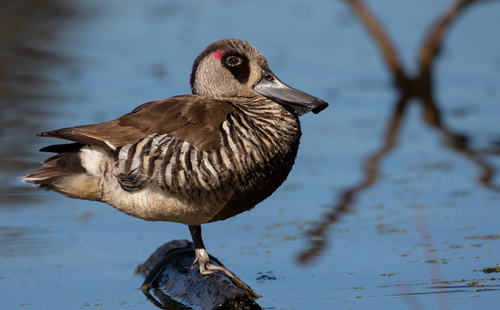
The pink-eared duck, scientifically named Malacorhynchus membranaceus (Latham, 1801), has a large spatulate bill similar to that of the Australasian shoveler, but is smaller in size, measuring 38–40 cm in total length. This species can be easily distinguished by its brown back and crown, black and white barred sides, and black eye patches set against an otherwise white face. Juvenile pink-eared ducks have slightly duller plumage than adults, but all other age and plumage types look very similar. The common name "pink-eared duck" comes from a small pink spot located at the corner formed by the bird's black head pattern; this spot is only visible when observed at close range. This makes the origin of the less commonly used Australian alternative name "zebra duck" far more obvious from the bird's appearance.
Pink-eared ducks are widely distributed across Australia and are highly mobile. They can appear anywhere that holds standing water, and are particularly common in dry inland regions where annual rainfall rarely exceeds 380 mm (15 inches).
Their diet depends on plankton, as well as crustaceans, mollusks, and insects. Their bill is well adapted for straining tiny organisms: it has flexible mandibular flaps that channel water to let the ducks efficiently filter algae and other plankton. They also use a specialized feeding behavior called vortexing: two ducks spin around a shared central point, with one duck's head positioned opposite the other's tail. This movement concentrates food within the swirling column of water to make feeding easier.