About Mairia coriacea Bolus
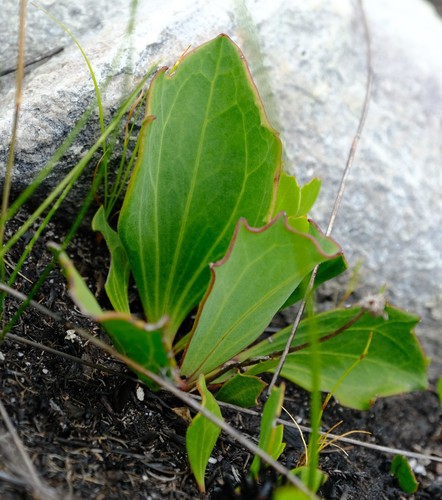
Mairia coriacea Bolus is a geophytic perennial herb that reaches approximately 12 cm (4 4/5 inches) in height, with dense, silky orange-brown hairs covering its growing points. It grows from a rhizome, with succulent dark brown to black roots that can grow up to 20 cm (8 inches) long and 3–4 mm (0.12–0.16 inches) thick. Each growing point typically produces up to six leathery bright lime-green leaves. Leaves may be stalkless, or carry a leaf stalk up to 10 cm (4 inches) long, and are either flat or curved downward. Most leaf blades are obovate (inverted egg-shaped), though some are elliptic or broadly elliptic; they measure 6–23 cm (2 2/5–9 inches) long and 3–21 cm (1 1/5–8 1/5 inches) wide. Leaf tips range from blunt to pointed, and their thickened margins are usually smooth (entire), though some may have broad teeth near the tip. Each leaf mostly has five slightly curved main veins, connected by a network of distinct secondary veins. Leaf hairiness varies: leaves may be hairless on both surfaces, or upper surfaces may start woolly and become hairless over time while lower surfaces range from sparsely to densely woolly. In all cases, the leaf surface remains visible through any hair covering. Flowering of Mairia coriacea typically occurs after fire, so when flower stalks emerge, most existing leaves are already burnt or scorched away. Each leaf rosette produces 2 to 8 ribbed inflorescence stalks that are usually 3–10 cm (1 1/5–4 inches) long (with a full size range of 5–17 cm / 2–6 3/5 inches). Stalks are tinted dark purple toward the top, covered in a thin to dense layer of white woolly hairs, and scattered with dark red glandular hairs. Stalks also bear several dark purple, linear or narrowly obovate bracts that measure 1–3 cm (2/5–1 1/5 inches) long and 2–4 mm (0.04–0.08 inches) wide, with pointed tips. Bract surfaces are hairless or carry some woolly and glandular hairs, but their axils are densely woolly. Most stalks carry a single flower head, rarely up to three. Each flower head contains ray florets and disc florets, surrounded by approximately 24 (up to 30) involucral bracts arranged in three to four overlapping whorls. The involucre is broadly bell-shaped, 12–15 mm (0.47–0.59 inches) long, and usually 17–22 mm (0.67–0.87 inches) in diameter, exceptionally reaching up to 30 mm (1.2 inches). Outer bracts are narrowly oval, mostly 6–7 mm (0.24–0.28 inches) long (up to 11 mm) and 1 3/4–2 1/4 mm (full range 1 1/2–3 mm) wide, with pointed tips, a purplish woolly-fringed margin, and a few woolly and glandular hairs on their surface. Inner whorl bracts are very narrowly obovate to oblong, usually 11–12 mm (0.43–0.47 inches) long (rarely up to 16 mm / 0.63 inches) and 1 3/4–2 mm (0.07–0.08 inches) wide. They have tapering pointed tips, a papery purple upper margin fringed with long woolly hairs, and an almost hairless surface. Each flower head holds around 20 female ray florets, which have linear pink, bright violet, or whitish straps 9–11 1/2 mm (occasionally up to 30 mm) long, with mostly three (sometimes five or seven) veins, three small teeth at the tip, and a base tube covered in many glandular hairs. While functionally female, these florets have five staminodes surrounding the style shaft. The style is 5–7 mm (0.20–0.28 inches) long, with purplish linear to elliptic style branches 1–1 1/2 mm long at its tip, which end in a blunt point. Ray florets surround numerous bisexual disc florets with a yellow corolla 7.2–8.0 mm (0.28–0.31 inches) long, which is mostly shorter than the pappus. The tubular base of the corolla carries glandular hairs, and its five triangular lobes curve backward at the tip, often bear a few hairs, and have a resin duct along each margin. Inside the corolla, five anthers are merged into a tube; when the floret opens, the style grows through this tube, collecting pollen onto its shaft. The anthers are 1 1/2–2 mm long, with small triangular appendages at their top. The style is approximately 8 mm (0.31 inches) long, with two dark red to purplish narrowly elliptic branches 1–2 mm (0.039–0.079 inches) long; each branch has a deltoid appendage about 0.2 mm wide and 0.3 mm long. Surrounding the base of the corolla for both ray and disc florets are many whitish or straw-colored pappus bristles arranged in two whorls. The outer whorl consists of a few delicate, free, feathered bristles 2.7–3.0 mm (0.11–0.12 inches) long. The inner whorl is made of 6–9 mm (0.24–0.35 inches) long feathery bristles, which are merged into a ring and barbed at their base. The dry, one-seeded indehiscent fruits (called cypselae) of both ray and disc florets are cylindrical to spindle-shaped, 4 1/2–5 mm long and 1–1 1/3 mm wide, and range from bright to light brown. Each cypsela has four or five narrow, barely visible ribs, and its surface is covered with silky silvery twin hairs 0.70–0.75 mm (0.028–0.030 inches) long with distinctly unequal arms, plus shiny golden yellow glands. Flowering is erratic, and occurs 6 to 8 weeks after fire burns away overhead vegetation. Sources conflict on the exact flowering window, noting it can fall anywhere between October and June. In the wild, Mairia coriacea is only found in the southwest of South Africa's Western Cape province. It occurs on the Cape Peninsula, and from the Kogelberg along the coast to the Breede River delta. It grows in fynbos vegetation, on rocky slopes in coastal mountains, or on sandy flats at the foot of limestone hills.