About Maireana pyramidata (Benth.) Paul G.Wilson
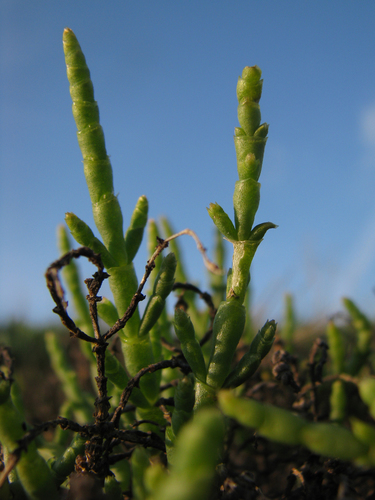
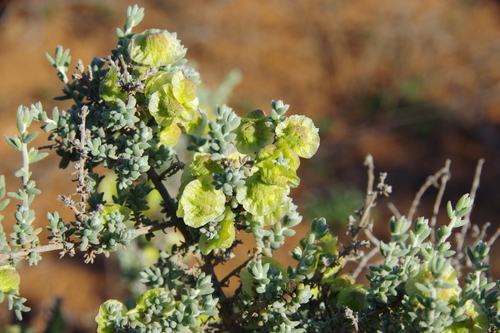
Maireana pyramidata is a compact, dense, stiffly branched shrub, commonly called sago bush, that usually grows between 0.3 and 1.5 metres (1 foot 0 inch to 4 feet 11 inches) tall. It has woolly branchlets. Its leaves are arranged alternately, spreading, and shaped either linear or narrowly lance-shaped. The leaves are more or less terete, 2 to 6 millimetres (0.079 to 0.236 inches) long, and covered with fine, woolly hairs that lie pressed against the leaf surface. Flowers of this species are mostly unisexual, and plants are frequently dioecious; all flowers are covered with woolly hairs. When dry, the fruiting perianth ranges in color from pale brown to black. The perianth tube is flat to top-shaped with thin walls, and the wing is papery, horizontal, and usually grows up to 12 millimetres (0.47 inches) in diameter. Fruiting mostly occurs between August and November. Sago bush is widespread across drier regions of Australia, where it grows on calcareous soils, saline flats, salt lakes, and areas that are typically prone to flooding. In Victoria, it occurs only in the far north-west, specifically in Mildura, Red Cliffs, Culluleraine, and the Kerang-Swan Hill district. In Western Australia, it is found in the Avon Wheatbelt, Carnarvon, Coolgardie, Central Ranges, Gascoyne, Gibson Desert, Great Sandy Desert, Great Victoria Desert, Little Sandy Desert, Murchison, Nullarbor, Pilbara, and Yalgoo regions. In South Australia, it grows in the Broken Hill Complex, Channel Country, Eyre Yorke Block, Finke, Flinders Lofty Block, Gawler, Great Victoria Desert, Murray Darling Depression, Riverina, Simpson Strzelecki Dunefields, and Stony Plains bioregions. This species is also found in the far south of the Northern Territory, and in the Far West of New South Wales.