About Maireana decalvans (Gand.) Paul G.Wilson
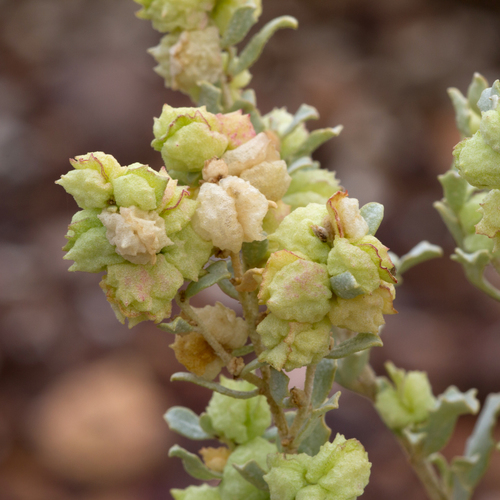
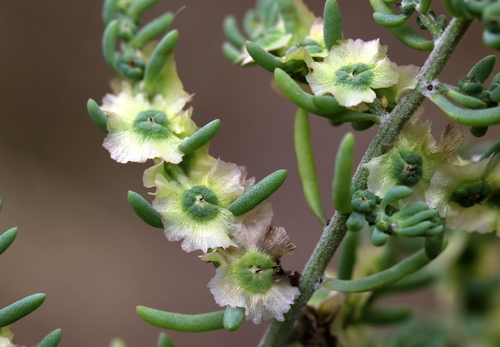
Maireana decalvans, commonly known as black cottonbush, is an erect to spreading, bushy perennial plant. It typically grows up to 50 cm (20 in) tall and produces thin branches. Its leaves are arranged alternately, are circular in cross-section to narrowly spindle-shaped, measure 5–8 mm (0.20–0.31 in) long, and are glabrous and fleshy. The flowers are bisexual, glabrous, and arranged singly in leaf axils. The fruiting perianth has a thin-walled tube around 3 mm (0.12 in) in diameter, and a thin wing around 8 mm (0.31 in) in diameter with a single radial slit. This species grows in heavy, seasonally wet, waterlogged soil, and sometimes acts as a coloniser of cleared land. It is naturally found in western New South Wales (mainly along the Murray River floodplain), the mid-west and Melbourne-Bacchus Marsh areas of Victoria, south-eastern South Australia, and south-eastern Queensland. It has also become naturalised in the Cape Provinces of South Africa.