About Maianthemum racemosum (L.) Link
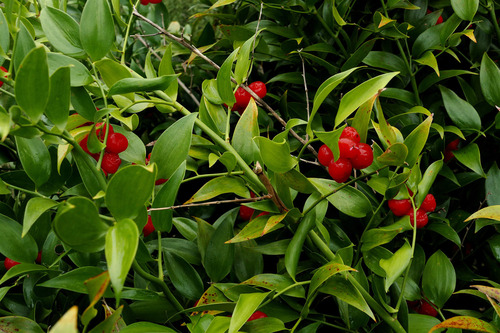
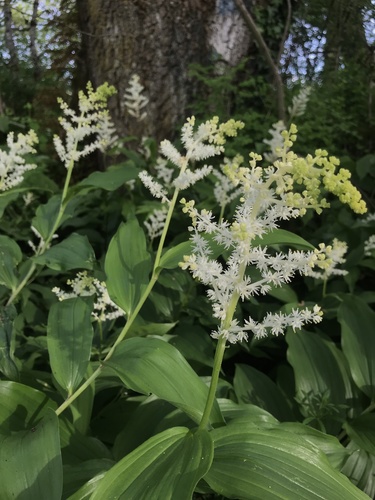
Maianthemum racemosum (L.) Link is a herbaceous perennial woodland plant. It grows 50–90 centimetres (20–35 inches) tall, with 7–12 alternate, oblong-lanceolate leaves that are 7–15 cm (2+3⁄4–6 in) long and 3–6 cm (1+1⁄8–2+3⁄8 in) broad. Leaf bases range from rounded to clasping or tapered, and sometimes attach to the stem via a short petiole; leaf tips range from pointed to long-tipped. It produces 7 to 250 small flowers on a 10–15 cm (4–6 in) panicle with well-developed branches. Each flower has six white tepals 3–6 millimetres (1⁄8–1⁄4 in) long, borne on a short pedicel that is usually less than 1 mm long. It blooms in mid-spring, and fruits develop by early summer. Fruits are rounded to 3-lobed, starting green with copper spots when young and turning red in late summer. The species spreads via cylindrical rhizomes up to 0.3 metres (1 ft) long, with scattered roots. M. racemosum closely resembles members of the distantly related highly toxic genus Veratrum, as well as baneberry. This species is widespread in its distribution. It is found across all Canadian provinces and territories except Yukon and Nunavut, all US states except Hawaii, and northern Mexico. The subspecies amplexicaule occurs in western Canada (Alberta, British Columbia, Northwest Territories, Saskatchewan), the western United States (Alaska, Arizona, California, Colorado, Idaho, Montana, Nevada, New Mexico, North Dakota, Oregon, South Dakota, Texas, Utah, Washington, Wyoming), and the Mexican states of Chihuahua, Coahuila, and Veracruz. The eastern subspecies, subsp. racemosum, occurs in Canada from Manitoba eastward, and in all eastern US states. Both subspecies are present in the Dakotas and Texas. In North America, M. racemosum grows in habitats at elevations up to 2,743 m (9,000 ft). Its most robust, abundant populations are typically found in partial shade with deep, moist, soft soils. In western North America, common typical habitats include shaded ravines or riparian corridors, where its frequent understory associates are Dryopteris arguta, Trillium ovatum, and Adiantum jordanii. Like the closely related Polygonatum (Solomon's seal), this plant is suitable for cultivation in moist, humus-rich soil in a woodland garden setting or in dappled shade. It has received the Royal Horticultural Society's Award of Garden Merit. Because it resembles highly toxic Veratrum genus plants, M. racemosum should never be consumed without positive, certain identification. After the plant finishes flowering and seeding, its tissues become fibrous and bitter, but tender young shoots can have their leaves stripped away, be simmered in water, and eaten. These shoots have a delicate flavor somewhat similar to asparagus. Ripe fruits are edible raw or cooked, but may have a poor taste, and can act as a laxative if eaten in large quantities. The Ojibwa people harvested the plant's roots and cooked them in lye water overnight to remove bitterness and neutralize their strong laxative effects. Native Americans boiled the roots to make medicinal tea, which was used to treat rheumatism, kidney issues, wounds, and back injuries.