About Mahonia repens (Lindl.) G.Don
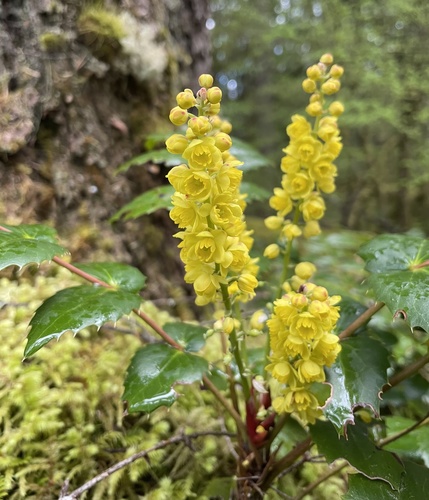
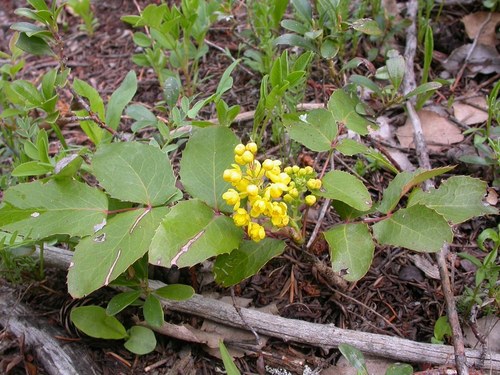
Mahonia repens (Lindl.) G.Don is also referred to as Berberis repens, creeping grapeholly. It is an extremely low-growing shrub, usually only 2–20 centimeters (0.79–7.9 in) tall, and very occasionally reaches 60 centimeters (24 in). Its stem bark becomes gray-purple or gray and is hairless. The plants spread via modified underground stems called rhizomes, which grow 1.5–5.0 centimeters (0.59–2.0 in) below the surface of mineral soil. Despite its short above-ground height, its roots can reach up to three meters deep into the ground. Its leaves are compound, with an odd number of leaflets attached to the main vein; leaves usually have five or seven leaflets, but may have only three. A complete leaf structure measures 10–30 centimeters (3.9–12 in) in length. The upper surfaces of the leaflets are smooth and dark green, while the undersides are lighter green and covered in fine, downy hairs. Leaflet edges have between six and twenty-four teeth tipped with spines. Although it is evergreen, its leaves will partially or fully turn bronze or red in fall and winter when exposed to sun. Flowers grow in a dense, unbranched inflorescence called a raceme. Each raceme holds between ten and fifty flowers, and is 4–10 centimeters (1.6–3.9 in) long. These yellow flowers bloom in early spring and are quite fragrant. Local conditions determine the exact bloom timing, which can be as early as February or as late as June. Each flower has six yellow sepals outside six yellow petals, with each petal tip split. It has a single pistil and six pollen-producing stamens that emerge when the petals or sepals are touched. Berberis repens produces distinct dark purple-black berries with a matte blue blush that contain one seed and resemble grapes. Each berry is roughly round, about 6–10 millimeters in size, and has a juicy texture. The berries have a quite tart flavor with an astringent quality, and are generally more attractive to birds than to humans. This species is native to the botanical continent of North America. In Canada, its range covers the southern parts of the provinces of Alberta and British Columbia. In the United States, it occurs across the west from Washington state to California, and eastward to Montana and New Mexico, including all states between these areas. East of the Rocky Mountains, it is also found in the US states of Texas, North Dakota, South Dakota, Nebraska, and Minnesota. It has also been recorded as an introduced species in Ontario, Canada and Hungary in the European Union. NatureServe also lists it as introduced to the US states of Pennsylvania and Delaware. It is widespread, found at low to mid elevation on dry plateaus, in forests, and on foothills. It associates with many different ecosystems across the western US and Canada, including grand fir forests, mountain and basin big sagebrush, Rocky Mountain juniper stands, western larch forests, pinyon-juniper woodlands, lodgepole pine forests in the Sierra Nevadas and Rocky Mountains, ponderosa pine woodlands in the interior and Pacific Northwest, quaking aspen groves across the west, mountain grasslands, oak savannas in New Mexico and Arizona, and Gambel oak scrub. It grows at elevations ranging from 150 metres (490 ft) to 3,000 metres (9,800 ft). Creeping grapeholly generally increases in abundance after disturbances in forest ecosystems such as mild fires, severe fires, and logging, though severe-intensity fires may eliminate it in the short term. As a long-lived plant with a protected root system and seeds thought to persist in soil, it recovers quickly from low-intensity fires. Above-ground stems and plant parts in forest humus are vulnerable to fire damage, but the plant resprouts from undamaged rhizomes in mineral soil. Its abundance decreases over time when the forest canopy is too dense, though it can tolerate significant shade, and it increases as other plants are negatively impacted by soil acidification caused by conifer trees. The leaves and stems are slightly poisonous to livestock and not very palatable. It is considered poor forage for both horses and cattle, but is rated fair forage for sheep in Utah and Wyoming. It is browsed by various wild animals. Elk and white-tailed deer both consume creeping grapeholly in winter, and consume it to a greater extent when weather is mild and less snow covers the plants. Mule deer also readily eat its leaves and stems during winter and early spring, and under certain conditions it can make up the largest portion of their winter diet. It is also eaten to some degree by the Mountain cottontail rabbit, and heavily eaten by the snowshoe hare in winter. The berries are consumed by many species of birds and small mammals, but are not a significant portion of their diet. No specific bird associations have been recorded other than with the sharp-tailed grouse. The berries are edible, but are considered bitter. Wild-harvested berries are used to make jellies or wine with added sugar. The Tolowa and Karok Indians of Northwest California used the roots to make a blood and cough tonic. The Hopi, Paiute, Navajo, Shoshoni, Blackfoot, Cheyenne, Mendocino, and other tribes have also used this plant for medicinal, food, and ceremonial purposes. Native Americans also used stem wood to produce yellow dye for staining woven baskets. Creeping grapeholly is cultivated as an ornamental plant for use in natural landscaping, as well as in water-conserving, drought-tolerant, traditional residential, native plant habitat, and wildlife gardens. It is a low-water ground cover, and is used in gardens under oaks to reduce or eliminate irrigation that can threaten mature trees. It is also a good companion plant for western North American trees or bushes such as Rocky Mountain bristlecone pine, golden currant, or Rocky Mountain juniper. Its foliage is resistant to deer browsing, though deer will eat it to some extent in winter. Because of its spreading growth habit, it is used to control erosion in dry areas, though it is not a fast-spreading plant. Its very deep and extensive root system gives the plant its adaptation to low-water conditions. Plants grown from seed are widely available from commercial and non-profit sources, but no cultivars have been developed. Bare root plants recover and establish more slowly than potted plants. Seeds are most likely to germinate after experiencing several cycles of warm and cold weather. Plants require well-drained soil, and prefer a soil pH of 5.5 to 7.0, but will tolerate pH between 4.5 and 7.5. In winter, leaves may become scalded by excessive sun, especially when combined with dry winds. Sources disagree on the winter hardiness of creeping grapeholly. In their book, Nora Harlow and Saxon Holt list it as hardy in USDA zones 4–10. The North Carolina Extension similarly lists the hardiness range as 4b–9b. However, the Missouri Botanic Garden lists a narrower range of only zone 5–8. The leaves are particularly sensitive to airborne fluoride pollution. Unlike other related species such as Berberis aquifolium, Berberis bealei, or Berberis fortunei, creeping grapeholly is immune to mahonia rust (Cumminsiella mirabilissima). Plant size is determined by water availability: the shortest stem sizes grow with minimal water, while larger stems grow closer to the maximum of the plant's moisture tolerance.