About Mahonia nervosa (Pursh) Nutt.
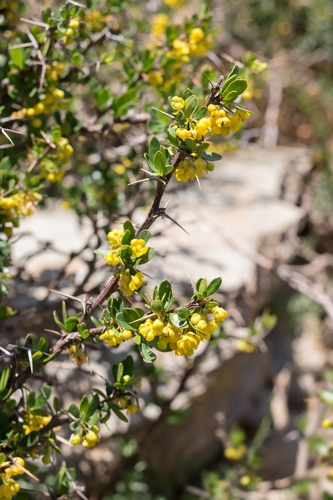
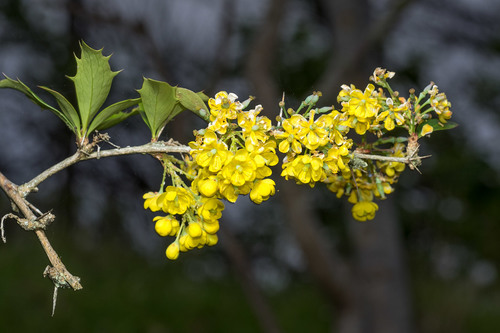
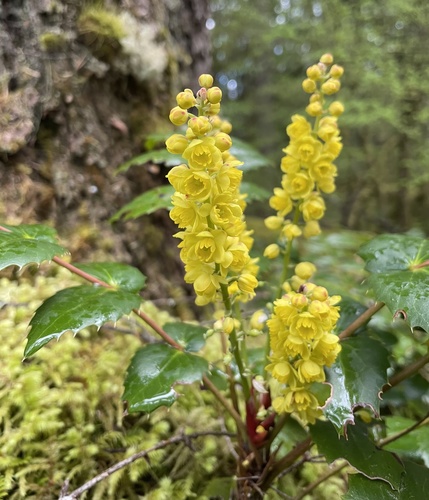
Mahonia nervosa (Pursh) Nutt. is an evergreen shrub with short, vertical stems that are mostly less than 61 centimetres (24 inches) tall; its leaves grow taller than the stems, and may very rarely reach 2.1 m (7 ft) tall in exceptional growing sites. This plant can reproduce both sexually via seeds and asexually through vegetative sprouting from rhizomes that grow laterally through soil. Its leaves are compound, oppositely arranged, and hold between 9 and 21 leaflets. Each leaflet grows up to 7 cm (3 in) long, has strongly toothed edges, has a slightly shiny surface (less shiny than the leaflets of tall Oregon-grape), and looks similar to holly leaves. Unlike tall Oregon-grape, whose leaflets have a single central vein, the leaflets of this species have several fan-arranged veins that branch from the base of the leaflet, which gives the species its epithet nervosa. Flowering occurs from early to late spring; the small yellow flowers, similar to those of other Oregon-grapes, form erect clusters up to 20 cm (8 inches) in length. The fruits are dark-blue, globose berries 7 millimetres (1⁄4 inch) in diameter that grow in clusters and have a tart taste. This species is native to the northwest coast of North America, ranging from southern British Columbia south to central California, with one isolated inland population located in northern Idaho. It is especially common in second-growth Douglas-fir or western redcedar forests, where it uses the intermittent pools of sunlight that reach the forest floor. It has been classified as an invasive exotic species in the Southeastern United States, where it may displace native vegetation. Commonly called low Oregon-grape, this species thrives in both sun and shade, and is a common or dominant understory species across montane, sub-montane, and mixed evergreen forests in the Pacific Northwest. It reaches its greatest abundance on relatively dry, warm sites, but also grows in fairly moist environments, and tolerates a wide variety of soil types. It is restricted to lower elevations, growing from sea level up to 1,800 m (6,000 ft). Mahonia nervosa is also sometimes classified as Berberis nervosa; it can complete its full life cycle even in the deep shade of dense hemlock-western redcedar forests, so it acts as a climax species and is often dominant in old-growth forests. It also grows in disturbed sites, and typically reaches peak abundance 4 to 10 years after wildfire or clearcutting. In some areas, black-tailed deer and Roosevelt elk browse its foliage, while in other areas these animals ignore the plant. Various small mammals feed heavily on its foliage, and it is an extremely important food source for the white-footed vole in Oregon's Coast Range. Small birds, small mammals, and black-tailed deer (in some areas) eat its fruits. Anna's hummingbirds favor nectar from plants in the Berberis genus, which this species is sometimes placed in. Historically, the Yana people dried and ground the fruits to make mush; the fruits can also be dried and eaten like raisins, or cooked to make jelly. Some Plateau Indian tribes drank a root infusion to treat rheumatism. In modern medicine, the plant is used to treat parasites, bacterial infections, viral infections, diabetes, and high cholesterol. The inner bark gets its yellow color from the alkaloid berberine, and was used as a dye by Indigenous groups. The leaves are often used in floral arrangements.