About Mahonia bealei (Fortune) Carrière
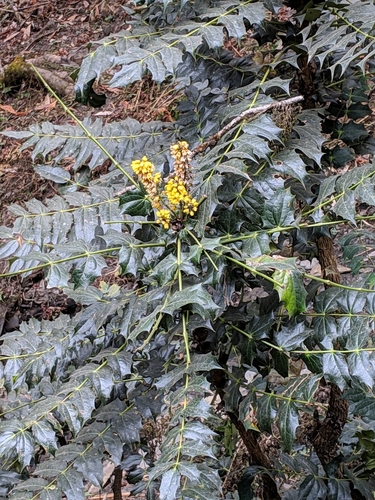
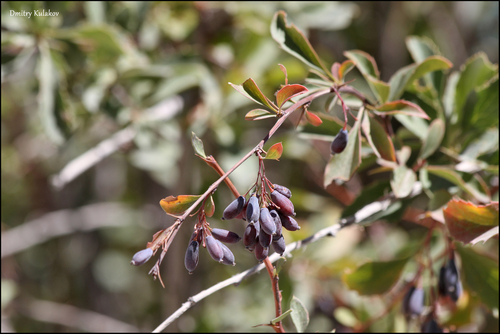
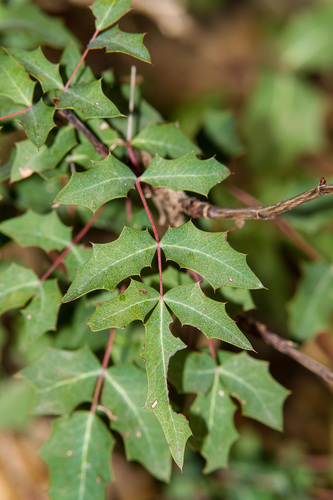
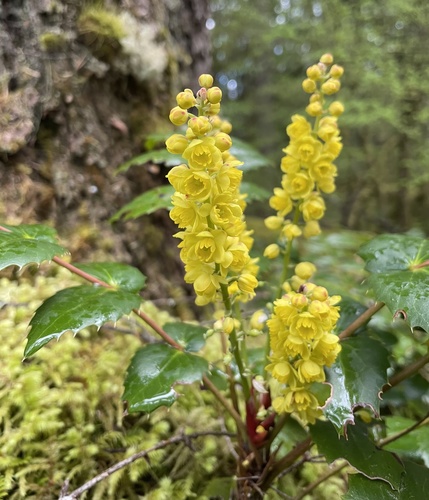
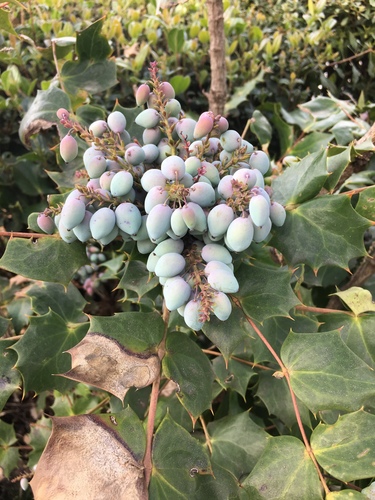
Mahonia bealei (Fortune) Carrière, also called Berberis bealei and leatherleaf mahonia, is a multi-stemmed evergreen shrub or small tree. It has irregular, strong upright stems that have very limited branching, and it grows up to 8 metres (26 ft) tall. This species has pinnate compound evergreen leaves that can reach up to 50 centimetres (20 in) long. Each leaf holds 4–10 pairs of leaflets plus a much larger terminal leaflet; the sessile leaflets are edged with spines. Flowering occurs in late winter and early spring, producing fragrant lemon-yellow flowers, though the blooms are also described as showy but weakly unpleasant-smelling. The flowers grow in an erect raceme that can be up to 30 cm (12 in) long. Abundant egg-shaped berries develop by early winter, ripening in late summer. Berries are blue or dark purple, reaching up to 15 millimetres (5⁄8 in) long, and turn bluish black with a grayish bloom. They hang in grape-like clusters and are glaucous, covered with a white waxy coating. This species is native to China, where it occurs in Anhui, Fujian, Guangdong, Guangxi, Henan, Hubei, Hunan, Jiangsu, Jiangxi, Shaanxi, Sichuan, and Zhejiang. It was introduced to Europe in the 1800s, and has since been planted as an ornamental throughout Europe and the United States. Birds eat its seeds and spread them widely, and the species has become established and naturalized in parts of the U.S., particularly in the southern U.S. It is especially common in bottomland forests, and grows well in full shade to partial shade. It may fail to flower if it does not get at least a few hours of sun each day, and does not tolerate hot midday sun in southern growing zones. It is winter hardy to USDA Zones 7–9, where it grows easily in moist, well-drained soils in part shade (such as morning sun or dappled sun) to full shade. It can also tolerate full sun, though this often causes some foliage bleaching, and full sun is only tolerated in the cooler northern parts of its growing range. Established plants tolerate some dry soil and drought, and grow best in locations protected from strong wind. The plant spreads by suckering and by seed; unless naturalization is desired, suckers should be removed promptly when they appear. A single specimen shrub often produces little fruit; growing multiple shrubs together gives the best fruit production. It can be easily propagated from cuttings or seed, but it is considered invasive in the mid-Atlantic and Southeastern U.S. This species has been used to treat infections including strep throat, tuberculosis, and bacterial infections such as dysentery and food poisoning. It is high in tannins, and may help relieve muscle pain, arthritis, and aches associated with fever. Its fruits are boiled and strained for medicinal preparations. Plants of the genus Berberis have long been used as medicine in China to treat periodontitis, dysentery, tuberculosis, and wounds. The berries are used in pies, jellies, jams, beverages, and confections. The yellow flowers are eaten, or used to make a lemonade-like drink. Fermented and distilled berries can be used to make wine. Ripe berries are too acidic to eat raw, but can be mixed with sugars or other berries; they can be eaten raw, but have a high ratio of seed to pulp, so most are boiled and strained before use. Young leaves can be simmered in water and eaten. Mahonia bealei is not toxic when consumed in small amounts, and is only acidic.