About Mahonia aquifolium (Pursh) Nutt.
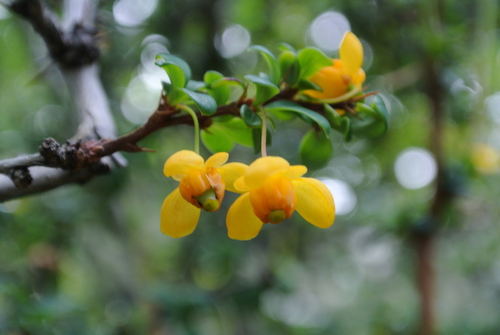
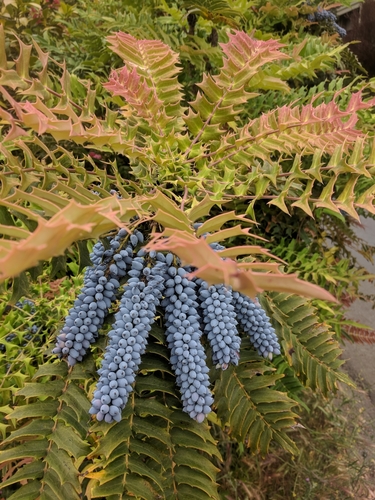
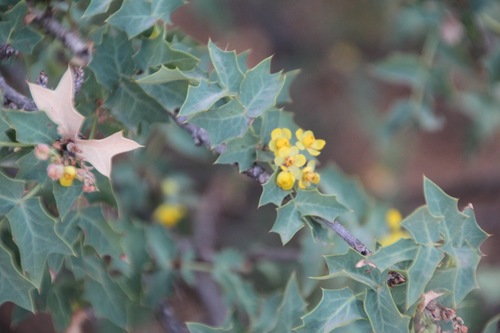
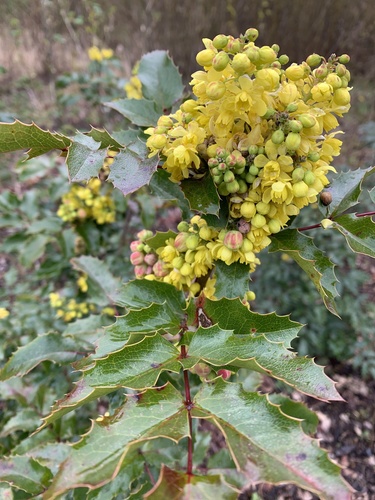
This species is currently referenced by both the scientific name Mahonia aquifolium (Pursh) Nutt. and Berberis aquifolium in this description. It grows 1–3 metres (3+1⁄2–10 feet) tall and 1.5 metres (5 feet) wide. Its stems and twigs have a thickened, corky appearance. The leaves are pinnate, reaching up to 30 centimetres (12 inches) long, and are made up of 5–7 ovate, spiny leaflets each up to 7.5 centimetres (3 inches) long. The leathery leaves are shiny on their upper surface and resemble holly leaves. Yellow flowers grow in dense clusters between March and June; these clusters are 3–6 centimetres (1+1⁄4–2+1⁄4 inches) long and 1.5 centimetres (5⁄8 inch) wide. Each of the flower’s six stamens ends in two spreading branches. Its six yellow petals are enclosed by six yellow sepals. Three greenish-yellow bracts sit at the base of the flower, and are less than half as long as the sepals. The plant produces spherical berries up to 1 centimetre (3⁄8 inch) wide, which are dark dusty-blue and have a tart flavor. Berberis aquifolium is native to western North America, ranging from Southeast Alaska to Northern California to central New Mexico. It commonly grows in the understory of Douglas-fir forests, though it can also be found in other forest types, as well as in brushlands across the Cascades, Rockies, and northern Sierra Nevada. Like some other Berberis species, B. aquifolium can act as an alternate host for wheat yellow rust (Puccinia striiformis f. sp. tritici, which typically prefers wheat), but it is not known if this host relationship occurs naturally. Wildlife eat the plant’s berries. Berberis aquifolium is a popular plant for shady or woodland garden plantings. It is valued for its striking foliage and flowers, which often open before the flowers of other shrubs. It is resistant to summer drought, tolerates poor soils, and does not produce excessive leaf litter. Its berries attract birds. Numerous cultivars and hybrids have been developed; the hybrid M. × wagneri 'Pinnacle' (a cross between B. aquifolium and Berberis pinnata) and the cultivar 'Apollo' have gained the Royal Horticultural Society's Award of Garden Merit. The plant’s small purplish-black fruits are quite tart and contain large seeds. They are edible raw after the first frost of the season, and were traditionally eaten in small quantities by Pacific Northwest indigenous tribes, mixed with salal or another sweeter fruit. Today, the berries are sometimes used to make jelly, either alone or mixed with salal. Oregon-grape juice can be fermented to make wine, following a folk tradition similar to that of European barberry wine, though making this wine requires an unusually high amount of sugar. The inner bark of the plant’s larger stems and roots produces a yellow dye. The berries contain a pigment that acts as a natural pH indicator, so the dye extracted from berries can be purple, blue, pink, or green depending on the pH of the water used. For medicinal use, some indigenous peoples of the Northwest Plateau use Oregon grape to treat indigestion. The plant contains berberine and is reported to have antimicrobial properties similar to those of goldenseal.